What Is AI Capability? How Enterprises Build It (and Why Most Stall)
AI capability is an organization’s ability to deploy, measure, and scale AI in a repeatable, value-driven way — not one-off projects, but an operating capability. What it includes, the maturity stages, why most efforts stall in pilots, and how to build capability you can trust.

AI capability is an organization’s ability to deploy, measure, and scale artificial intelligence in a repeatable, value-driven way. The key word is repeatable. In a mature organization, AI is not a pile of one-off projects — it is an operating capability: standardized delivery, secure access to data, clear oversight, and a consistent path from idea to production. A company has real AI capability when it can take a new use case from concept to trusted production without reinventing everything.
That is also where most companies fall short. The gap is rarely the model — modern models are remarkably capable out of the box. The gap is the surrounding capability: the data, governance, and trust that turn an impressive demo into something a business will actually run on.
What AI capability actually includes
- Data foundation — secure, well-governed access to the data AI needs, in usable form.
- Talent and ways of working — people who can build, evaluate, and operate AI, with shared practices.
- Platform and reusable components — retrieval patterns, evaluation harnesses, and logging that new use cases assemble from, rather than rebuild.
- MLOps — automated training, testing, deployment, and monitoring for consistency and reliability.
- Governance and oversight — clear accountability, controls, and a way to verify and audit what AI produces.
The maturity stages
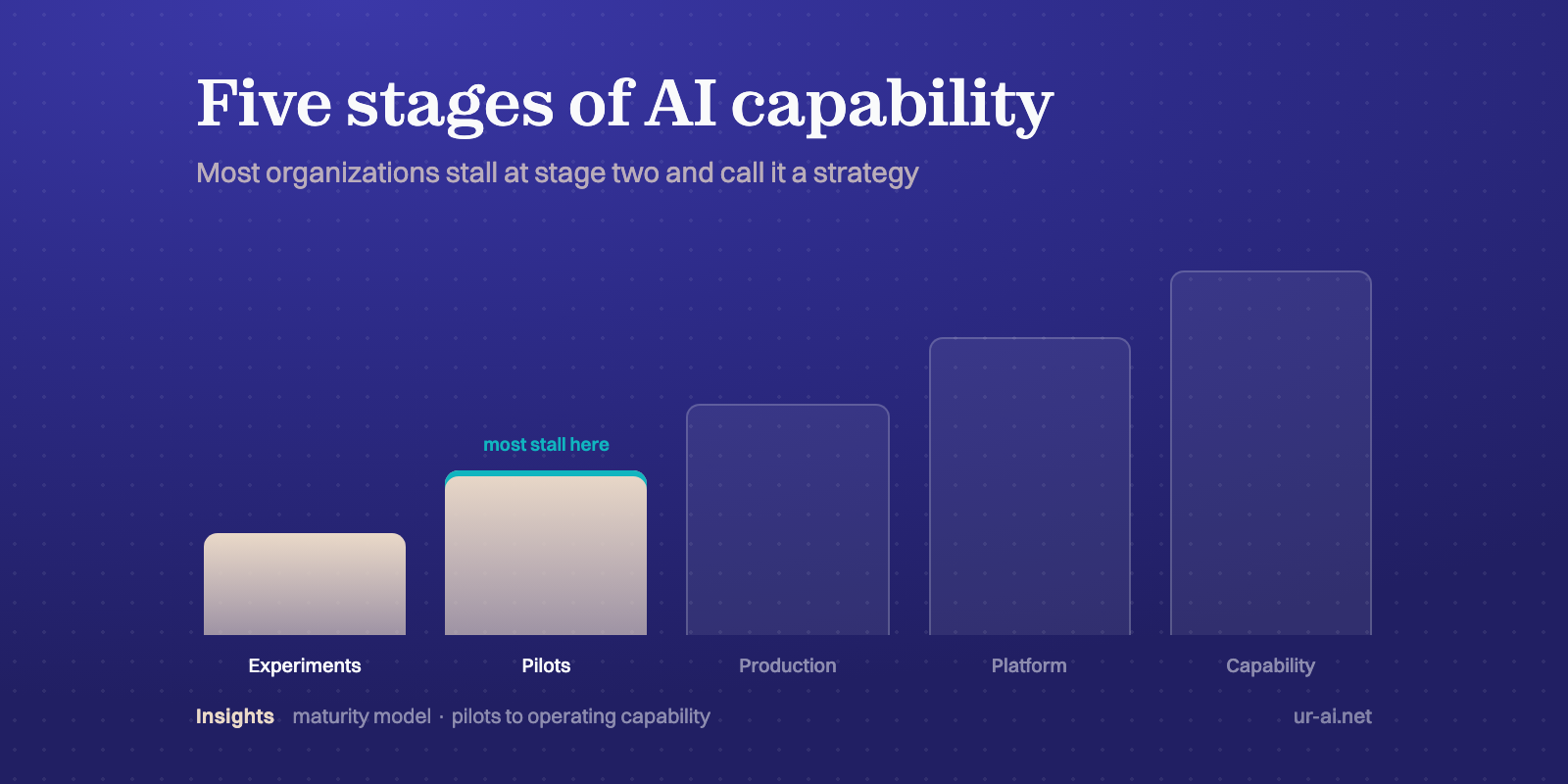
Most frameworks describe AI capability as a progression. The MIT CISR Enterprise AI Maturity Model uses four stages; Gartner uses five, from initial awareness to transformational. The shape is consistent: organizations move from scattered experimentation, through repeatable delivery, to enterprise-wide capability with measurable business impact. Maturity is not about using more AI — it is about using it reliably and at scale.
- Preparing & Experimenting — scattered pilots, building literacy and learning the basics.
- Building Pilots & Capabilities — repeatable delivery and shared components start to emerge.
- Scaling AI — capability runs across many use cases, with governance and oversight in place.
- AI Future-Ready — AI is embedded in how the business operates and creates value.
AI capability is not how advanced your models are. It is how reliably you can turn them into outcomes a business can trust.
Why most AI capability stalls
- Project mindset over platform mindset — building a bespoke solution for each use case instead of reusable capability.
- Data security and quality — the most cited blockers to scaling AI safely.
- A shortage of expertise — too few people who can take AI from demo to dependable production.
- No trust layer — output that cannot be verified or audited never earns the right to run on real decisions.
How to build AI capability
Building AI capability is a sequence, not a single leap. The organizations that get there tend to move in the same order: first a secure, usable data foundation; then a small set of reusable components — retrieval, evaluation, logging — that every new use case draws on; then governance and oversight so the output can be trusted; and only then breadth across many use cases. The shift that unlocks it is cultural — from a project mindset, where each use case is built from scratch, to a platform mindset, where capability compounds. A practical sign you are on the right track: your second AI use case is materially cheaper and faster to ship than your first.
Capability you can trust
The capability that compounds is the kind people trust. At Ur AI we build AI on a simple principle — AI you control, insights you trust, human x AI workflows — because capability that cannot be verified does not get used on decisions that matter. It is the same foundation under both of our products: Specter analyzes M&A data rooms with every finding cited to its source, and Nebula turns complex documents into structured, auditable data. Capability is not just what AI can do; it is whether your organization can rely on it.
A useful test of AI capability: can you take a new use case from idea to trusted production in weeks — reusing what you already built — rather than starting from scratch each time?
Frequently Asked Questions
What is AI capability?
AI capability is an organization’s ability to deploy, measure, and scale artificial intelligence in a repeatable, value-driven way. In a mature organization, AI is not a set of one-off projects — it is an operating capability with standardized delivery, secure access to data, clear oversight, and a consistent path from idea to production.
What is the difference between AI capability and AI maturity?
AI capability is what an organization can reliably do with AI; AI maturity is how far that capability has developed. Maturity models (MIT CISR uses four stages, Gartner five) describe the progression from early experimentation to enterprise-wide, value-driven use. Capability is the underlying competence; maturity is the stage it has reached.
How do you build enterprise AI capability?
You build it by shifting from a project mindset to a platform mindset: standardizing delivery, securing data access, building reusable components (retrieval, evaluation, logging, MLOps), and putting governance and oversight in place so AI output can be trusted. The hardest part is cultural — building capabilities that serve many use cases instead of bespoke solutions for each.
Why do most enterprise AI projects stall?
Most stall because they stay stuck in pilots: impressive demos that never reach production because the organization lacks the data foundation, governance, and trustworthy, auditable output needed to deploy at scale. Security and data-quality concerns and a shortage of expertise are the most cited blockers.