Generative AI in M&A Due Diligence: Use Cases, Risks, and What Actually Works
Generative AI is now mainstream in M&A — 86% of corporate and PE leaders use it, per Deloitte. This guide covers how GenAI is used in due diligence, the evidence on speed and cost, the real risks, and why auditable, human-led AI is the version that works.

Generative AI in M&A due diligence means using large language models to do a first pass over the data room — summarizing documents, comparing contract terms, flagging risks, and answering questions across thousands of files in minutes instead of days. It is no longer experimental: Deloitte’s 2025 study found 86% of corporate and private-equity leaders now use generative AI in their M&A workflows, and case studies report around 75% efficiency savings in due diligence versus manual review.
The shift has been fast. Most of those adopters came on board in the last year, and McKinsey reports that teams using gen AI in M&A see roughly a 20% cost reduction, with 40% reporting deal cycles that are 30–50% faster. The question for deal teams in 2026 is no longer whether to use AI in diligence — it is how to use it without trading speed for trust.
How generative AI is used in due diligence
Across deal teams, the highest-value generative-AI use cases in diligence are:
- Data room triage — summarizing and categorizing thousands of documents so reviewers know where to focus.
- Contract analysis — extracting and comparing change-of-control, assignment, exclusivity, and termination clauses at scale.
- Red-flag detection — surfacing inconsistencies, missing documents, and unusual terms across the file set.
- Q&A over the data room — answering specific questions ("what are the top 10 customer concentration risks?") with reference to source files.
- First-draft outputs — generating IC memo sections and risk summaries that humans then refine.
What the data says
- Adoption: 86% of corporate and PE leaders use GenAI in M&A; 35% of adopters apply it specifically to screening and due diligence (Deloitte, 2025).
- Efficiency: ~75% efficiency saving in due diligence versus traditional manual review (Deloitte case studies).
- Cost and speed: ~20% average cost reduction, and 40% of users report 30–50% faster deal cycles (McKinsey).
- Trajectory: roughly one in five companies use GenAI in M&A today, with more than half expecting to by 2027 (Bain).
The deal teams winning with AI are not the ones that adopted it first — they are the ones that made its output verifiable.
Why generic AI chatbots fail in due diligence
The speed is real, but so are the failure modes. A finding you cannot trace to a source document is worthless in a deal — and dangerous. The recurring problems are:
- Hallucination — confident answers that are not supported by the documents.
- No audit trail — you cannot show where a conclusion came from, so it cannot survive IC or legal review.
- Data security — 67% of M&A leaders rank security as their top GenAI concern (Deloitte); confidential deal data does not belong in consumer chatbots.
- Data quality — flattened OCR text and lost table structure produce wrong answers from right documents.
What actually works: human-led, auditable AI
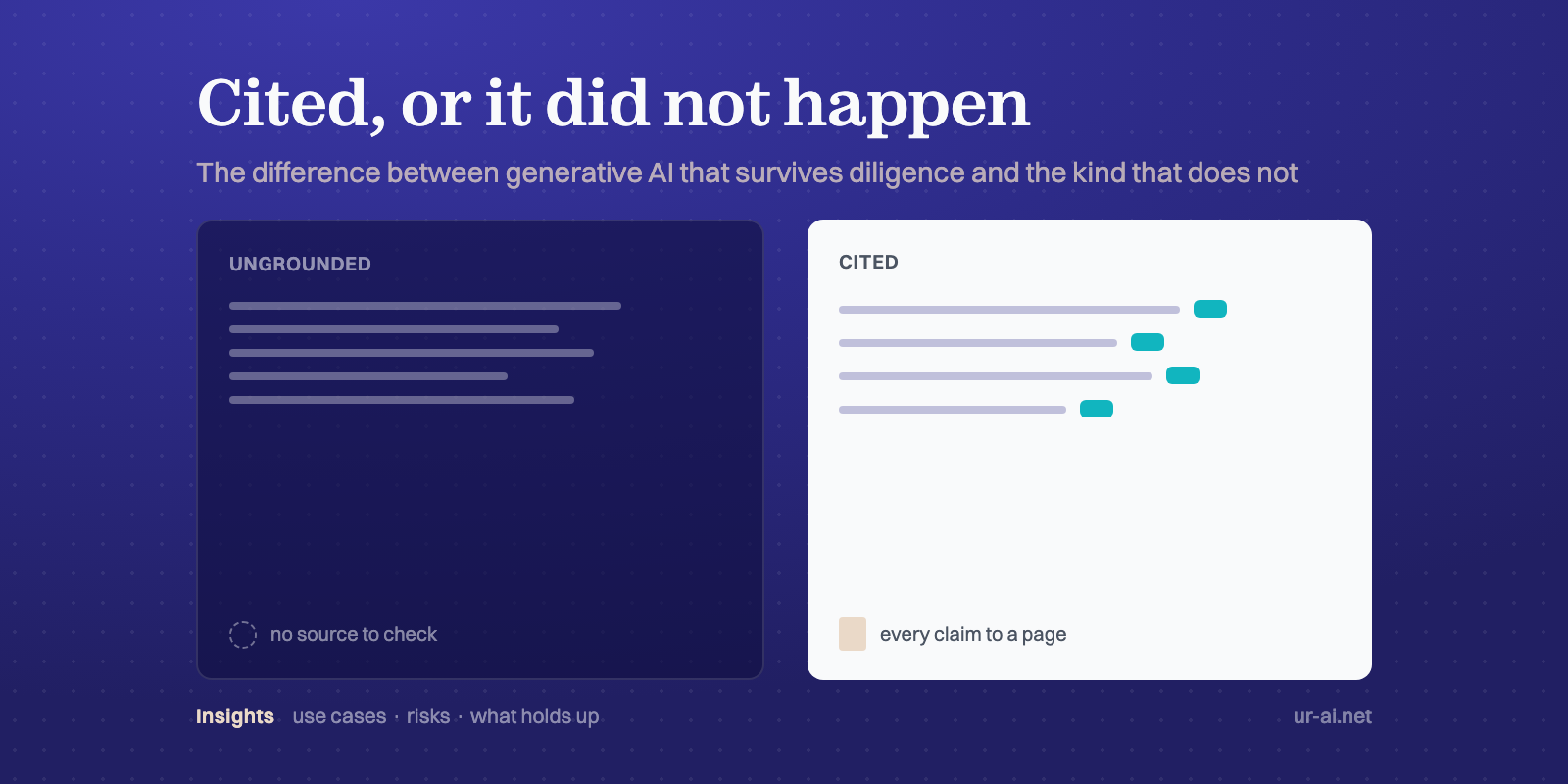
The version of generative AI that holds up in diligence is the one built for it. That means every finding is cited back to the exact source document, the architecture is fully auditable, and a human stays in control of what is accepted — AI does the reading, people make the judgments. This is the principle Specter is built on: it analyzes data rooms in minutes, cites every claim to its source, and runs on ISO 27001-certified infrastructure so confidential deal material stays controlled.
Rule of thumb: if your AI cannot show you the source sentence behind a finding, treat the finding as a lead to verify — not as an answer.
Frequently Asked Questions
How is generative AI used in M&A due diligence?
Generative AI is used in due diligence to perform a first pass over the data room: summarizing documents, extracting and comparing key contract terms, flagging risks and inconsistencies, and answering questions across thousands of files in minutes. Deloitte reports that 35% of GenAI adopters in M&A use it for target screening and due diligence, and case studies show roughly 75% efficiency savings versus manual review.
Does generative AI make due diligence more accurate?
It can, but only when it is used correctly. Generative AI speeds up review and surfaces issues a tired reviewer might miss, but general-purpose chatbots can hallucinate and cannot prove where an answer came from. Accuracy depends on grounding the AI in the actual documents, citing every finding to its source, and keeping a human in control of what is accepted.
What are the risks of using generative AI in due diligence?
The main risks are hallucinated findings, confidentiality and data security (67% of M&A leaders cite security as their top concern in Deloitte’s survey), poor data quality, and a lack of auditability — if you cannot trace a conclusion back to a source document, it cannot be relied on in a deal. These risks are managed with source citations, an auditable architecture, and human oversight.
Is it safe to use AI on confidential deal documents?
It is safe only with enterprise controls: documents that are not used to train external models, strong access controls, and a verifiable audit trail. Consumer chatbots are not appropriate for confidential deal material. Purpose-built platforms like Specter are designed for this: ISO 27001 certified, with per-finding citations.