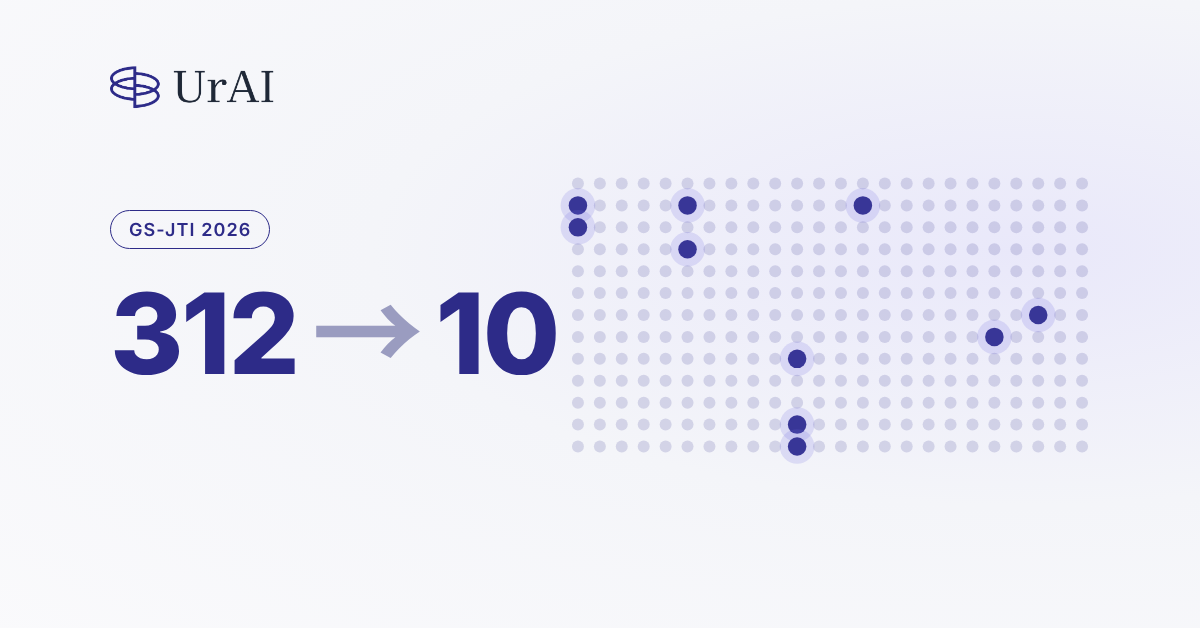
Ur AI selects 10 interns from 312 applicants in METI's Global South internship program
Through METI's GS-JTI program we received 312 applications for our document intelligence R&D internship and selected 10 students, who join us in December. Here is what they will work on, and why we are betting on AI-native talent.

Ur AI is hosting its first intern cohort through the Global South - Japan Tech Talent Internship (GS-JTI), a program run by Japan's Ministry of Economy, Trade and Industry (METI) that connects students from Global South countries with companies in Japan.
We received 312 applications for our Document Intelligence and VLM R&D internship, and selected 10 students. They join us in December, and we are excited to welcome them.
The cohort
- 10 students from top universities such as the IITs and BITS Pilani in India, and BUET in Bangladesh.
- Four weeks of R&D between 7 December 2026 and 15 January 2027: two weeks remote, and two weeks with the team in Tokyo from 21 December to 1 January.
- All 10 chose to come to Tokyo.
How we selected: a test of AI-native ability
Alongside the program's own shortlisting and interviews, we ran an assessment of our own, built to measure AI-native ability. Candidates worked on a real document problem and could use any AI tool they liked. We were not testing whether someone can work without AI. We wanted to see how they work with it: how they frame a fuzzy problem, what they hand to the model, where they check its output, and whether they notice when it is confidently wrong.
What they will work on
The interns will work on a mix of projects from our R&D roadmap.
- Nebula projects: post-training vision-language models for document conversion, and language models for retrieval and reasoning, the work behind Nebula and Nebula Sovereign, which runs on open-weight models we post-train ourselves.
- A first step into science: we will start working on one of the Millennium Prize Problems, for example the Navier–Stokes equations or one of the open problems in pure mathematics, with post-trained models. We will pick the problem with the team. The aim is to build our research muscle on a problem far harder than any benchmark, and to show that our methods carry over beyond documents.
We are glad to have more talented people pushing on these research fronts with us.
Why we are betting on AI-native talent
I believe the people who grow up with AI as a given will build things the rest of us would not think of. For today's students, an AI model is not a new tool to adopt. It is part of how they learn, write and solve problems, at an age when ways of thinking are still forming. They have nothing to unlearn.
Those of us who built our careers before AI approach it differently. We re-think how we work, and we are very good at it: making today's workflows faster, cheaper and more reliable. That is real value, and much of what AI delivers right now.
But the next generation of products and services will not be today's workflows with AI added on. They will be designed around AI from the start, and I expect many of them to come from people who never knew another way of working. Putting that instinct next to the experience in our team is what this program is about for us.
Thank you
Thank you to METI and the GS-JTI program office for making this possible, and to all 312 applicants for the time and care you put into the problem. If you are a student who wants to work on hard document AI problems, follow our updates at ur-ai.net/blog, or write to us at contact@ur-ai.net.
Frequently Asked Questions
What is GS-JTI?
The Global South - Japan Tech Talent Internship (GS-JTI) is a program run by Japan's Ministry of Economy, Trade and Industry (METI). It connects students from Global South countries with internships at companies in Japan, including support for travel and visas for in-person internships.
How many people applied for the Ur AI internship, and how many were selected?
Ur AI received 312 applications for its Document Intelligence and VLM R&D internship through GS-JTI and selected 10 students from top universities in India and Bangladesh.
What will the interns work on?
A mix of Nebula R&D, such as post-training vision-language and language models for document conversion, retrieval and reasoning, and a first research effort on one of the Millennium Prize Problems in mathematics to build research capability beyond documents.
When does the internship take place?
Over four weeks between 7 December 2026 and 15 January 2027, including two weeks in person in Tokyo from 21 December 2026 to 1 January 2027.