How Much Does M&A Due Diligence Cost? A Practical Guide for 2026
M&A due diligence cost is driven mostly by deal size, scope, and the volume of documents reviewed. This guide breaks down typical ranges, the cost of each workstream, and how AI cuts the largest expense — review hours.

M&A due diligence cost varies widely with deal size and scope, but the price is driven mostly by two things: how many advisory workstreams you engage and how many documents have to be reviewed. As a rough guide, professional fees run from tens of thousands of US dollars for a small, single-workstream review to several hundred thousand dollars or more for a mid-market deal covering financial, legal, tax, and commercial due diligence.
Most cost overruns in due diligence are not caused by advisor rates. They are caused by scope that expands mid-process and by the sheer number of hours spent reading a data room. Understanding where the money goes is the first step to budgeting a deal that does not blow past its estimate.
What drives the cost of due diligence?
Two deals of the same headline value can carry very different due diligence bills. The main cost drivers are:
- Deal size and complexity — larger, multi-entity targets require more workstreams and deeper review.
- Scope — how many types of due diligence you run (financial, legal, tax, commercial, IT, HR, environmental).
- Document volume — the number of files in the data room, which directly sets review hours.
- Cross-border factors — multiple jurisdictions, languages, and accounting standards add specialist fees and time.
- Advisor seniority and rates — partner-level hours cost far more than associate hours.
- Timeline pressure — compressed schedules often mean more people working in parallel, at a premium.
Due diligence cost breakdown by workstream
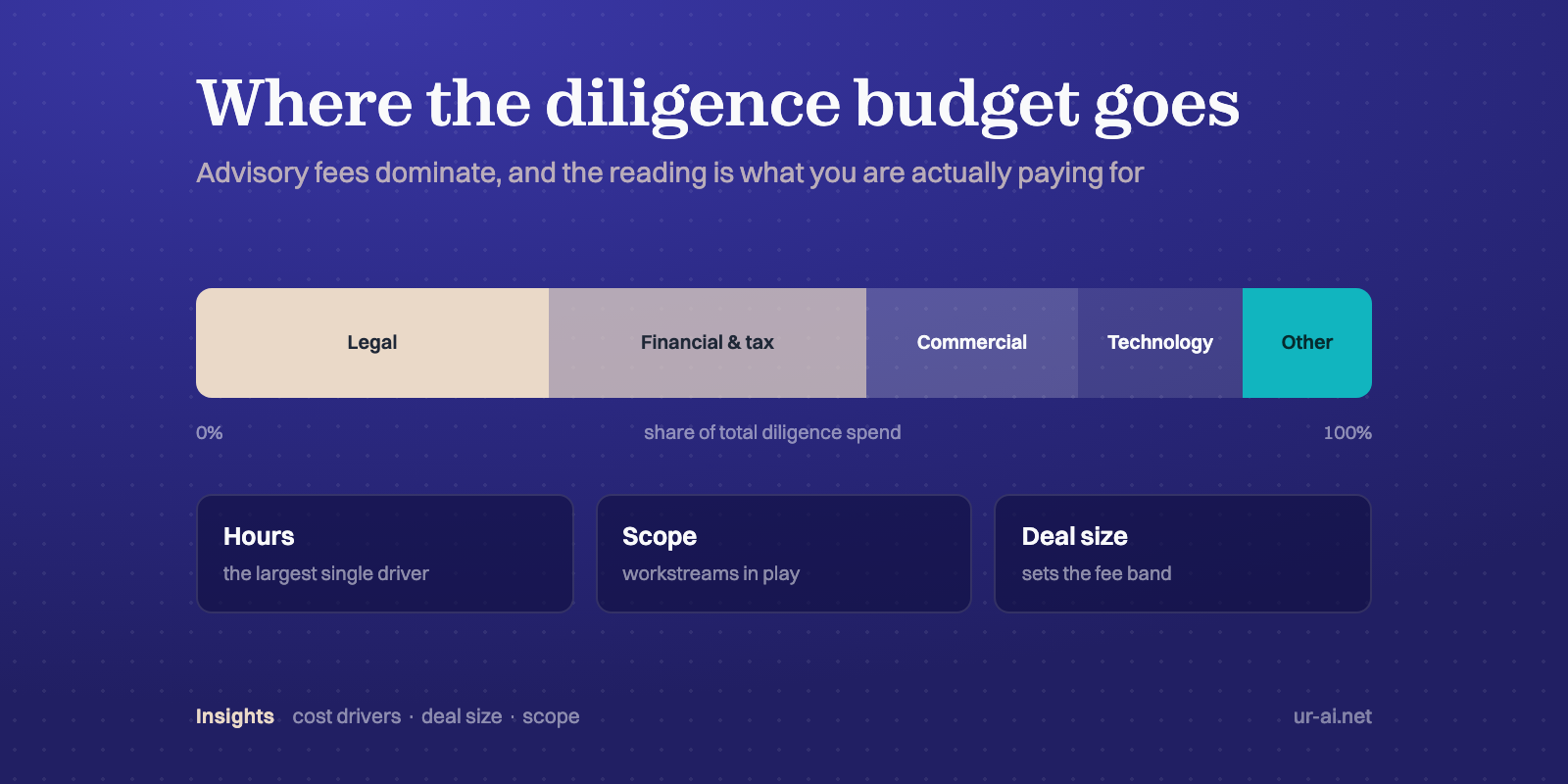
On a typical mid-market transaction, the fee split across workstreams looks roughly like this — though the mix shifts with the target and the risks that matter most:
- Financial due diligence — often the largest share; quality-of-earnings, working capital, and debt analysis.
- Legal due diligence — contracts, litigation, intellectual property, corporate records, and compliance.
- Tax due diligence — historical exposures, structuring, and transfer pricing.
- Commercial due diligence — market, competitive position, and revenue durability.
- Specialist reviews — IT, cyber, HR, ESG, or environmental, engaged as the deal requires.
Typical cost ranges by deal size
These ranges are illustrative — actual fees depend on scope, advisors, and geography — but they give a working sense of scale:
- Small deals (under ~$10M): a focused review of one or two workstreams, often in the low tens of thousands of dollars.
- Mid-market deals (~$10M–$250M): a full multi-workstream process, commonly in the low-to-mid six figures.
- Large or complex deals: cross-border, regulated, or carve-out transactions can run well into seven figures.
The single biggest controllable cost in due diligence is not advisor rates — it is the hours spent reading documents.
Where the hidden costs hide
The estimate you sign off on rarely includes the costs that actually break budgets: scope creep as new questions emerge, re-review when a fresh batch of documents lands late, and the carrying cost of a slow process — deal fatigue, distracted management, and the risk of a competing bidder moving faster. Time is a cost, even when no one is invoicing for it.
How AI reduces due diligence cost
Because document-review hours are the largest line item, the most direct way to cut cost is to compress them. AI can perform a first pass over the entire data room in minutes — extracting key terms, flagging risks, and surfacing inconsistencies — so advisors spend their senior-rate hours on judgment rather than on reading. That lowers both fees and timeline without lowering rigor.
This only works if the AI is trustworthy. Specter, our AI platform for M&A due diligence, analyzes data rooms in minutes, cites every finding back to the source document, and keeps humans in control of what gets accepted — on a fully auditable architecture. The goal is not to replace the deal team but to give them back the hours that manual review consumes.
Budgeting tip: estimate review hours first, not advisor day-rates. If you can cut first-pass review time, you cut the largest and most variable part of the bill.
Frequently Asked Questions
How much does M&A due diligence cost?
M&A due diligence cost varies widely with deal size and scope. As a rough guide, professional fees range from tens of thousands of US dollars for a small, single-workstream review to several hundred thousand dollars or more for a mid-market deal that includes financial, legal, tax, and commercial due diligence. The two biggest drivers are the number of advisory workstreams engaged and the volume of documents that must be reviewed.
What is the most expensive part of due diligence?
The most expensive part is usually the time advisors spend reading and cross-checking documents in the data room. Senior-rate hours spent on manual review — often across thousands of files — typically outweigh fixed costs like data room software or filing fees.
How can you reduce due diligence costs?
You can reduce due diligence costs by tightening scope before you start, prioritizing the workstreams that carry real deal risk, reusing a structured request list, and using AI for first-pass document review so advisors spend their hours on judgment instead of reading. Cutting review hours is the most direct lever because it attacks the largest cost.
Does AI reduce due diligence costs?
Yes. AI reduces due diligence cost by automating first-pass review of the data room — surfacing key terms, red flags, and inconsistencies in minutes instead of days. Because document-review hours are the single largest cost in most deals, compressing them lowers both fees and timeline. Tools like Specter keep humans in control and cite every finding to its source so the work stays auditable.