How AI Is Transforming M&A Due Diligence in 2026
From automated document analysis to AI-generated IC memos, the industry is in the early innings of a technology shift that will redefine how deals get done.

AI is transforming due diligence in 2026 by enabling deal teams to analyze entire data rooms in minutes, generate fully cited reports, and conduct multi-language analysis — tasks that previously required weeks of manual work. According to Deloitte, 86% of organizations have now integrated GenAI into their M&A workflows, with adoption accelerating sharply over the past year.
The M&A technology landscape has changed more in the past 18 months than in the prior decade. What was once limited to basic document management and virtual data rooms has evolved into an ecosystem of AI-powered tools that can read, analyze, and synthesize thousands of documents in the time it takes a human analyst to review a single contract.
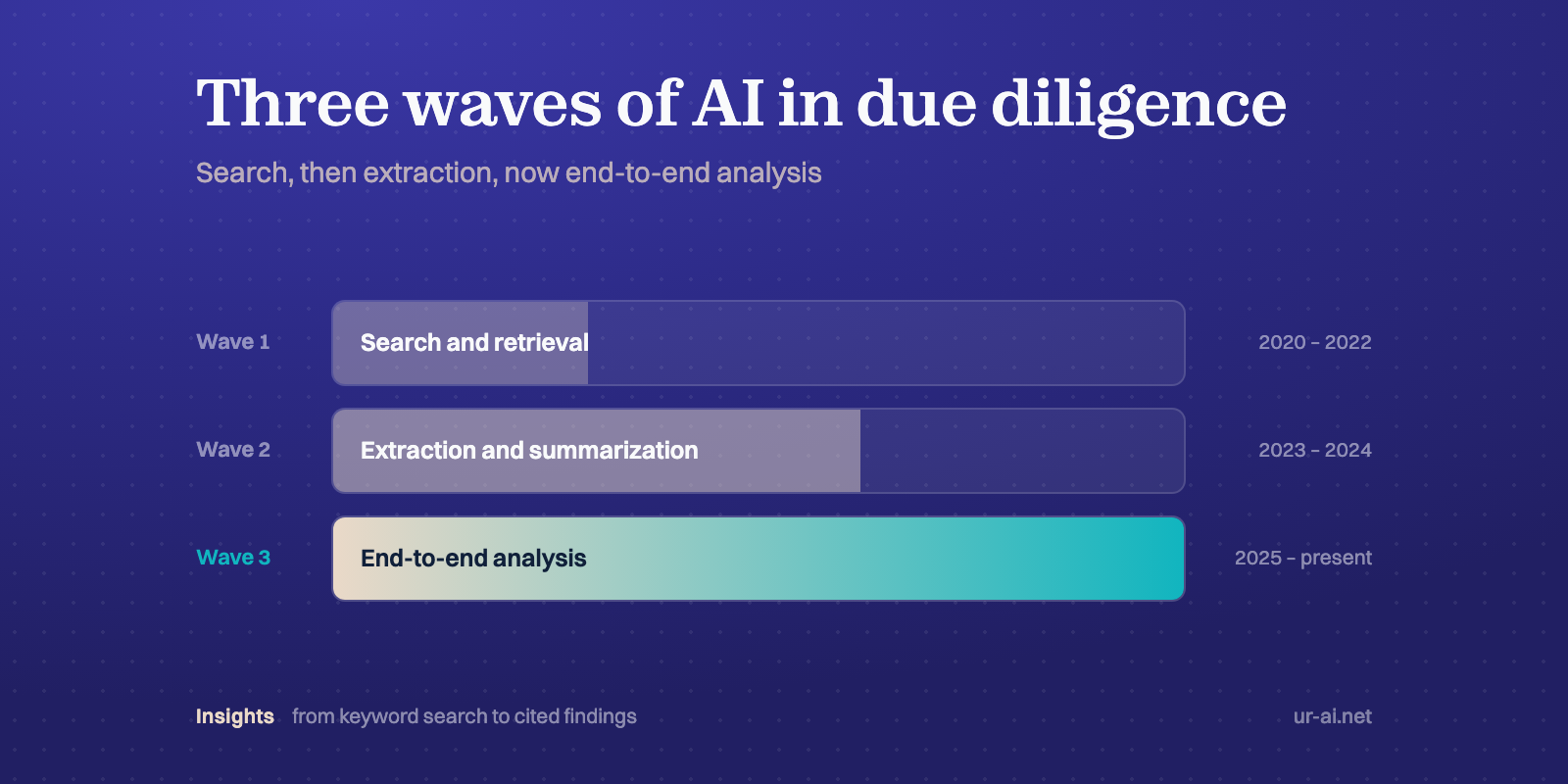
The Three Waves of AI in Due Diligence
Wave 1: Search and Retrieval (2020–2022)
The first wave brought smarter search. Instead of manually browsing folder hierarchies in data rooms, deal teams could use keyword and semantic search to find relevant documents faster. This was useful but limited — it still required humans to read and interpret every document.
Wave 2: Extraction and Summarization (2023–2024)
Large language models enabled automatic extraction of key terms, dates, and clauses from contracts. Deal teams could get summaries of individual documents, saving time on initial review. However, these tools often produced summaries without citations, making verification difficult and trust uncertain.
Wave 3: End-to-End Analysis (2025–Present)
The current wave — where Specter operates — goes beyond extraction. AI systems now analyze entire data rooms holistically, identify patterns across documents, flag risks that span multiple contracts, and generate comprehensive reports with full citation chains. Crucially, the human remains in control of the analysis direction.
What Sets 2026 Apart
- Fully auditable architectures — AI systems that refuse to state facts they cannot cite, eliminating the trust problem that plagued earlier tools.
- Iterative human-AI workflows — Rather than producing a single output, AI systems now support multi-round investigation where analysts can drill down, refine hypotheses, and explore edge cases.
- Multi-language analysis — Cross-border deals involving Japanese, English, Indonesian, Vietnamese, Spanish, Arabic, and other global languages can now be analyzed in a single workflow.
- IC-ready outputs — AI can structure findings into investment committee memo format, reducing weeks of post-analysis report writing to hours.
We are not building AI that replaces the deal team. We are building AI that makes every member of the deal team ten times more effective.
The Adoption Curve
Deloitte's 2025 GenAI in M&A Survey — based on 1,000 senior corporate and PE leaders — found that 86% of organizations have now integrated GenAI into their M&A workflows, with 65% doing so within the past year. Of those, 35% are applying it directly to target screening and due diligence. A separate McKinsey study published in January 2026 found that 40% of gen AI adopters in M&A report 30–50% faster deal cycles. The early adopters are gaining a structural advantage that will be difficult for laggards to close.
Sources
The firms that move first will win more deals, serve clients better, and operate with leaner teams. The question for every M&A professional is simple: which side of this shift do you want to be on?
Frequently Asked Questions
How is AI being used in due diligence in 2026?
In 2026, AI is used for end-to-end due diligence analysis: processing entire data rooms in minutes, generating cited reports, cross-referencing documents across languages, and producing IC-ready memos. Key advances include fully auditable architectures, iterative human-AI workflows, and multi-language document analysis.
What is the adoption rate of AI in M&A?
According to Deloitte's 2025 GenAI in M&A Survey of 1,000 senior corporate and PE leaders, 86% of organizations have integrated GenAI into their M&A workflows — with 65% doing so within the past year. McKinsey research published in January 2026 found that 40% of gen AI adopters in M&A report 30–50% faster deal cycles.
What are the three waves of AI in due diligence?
The three waves are: (1) Search and retrieval (2020-2022) — smarter document search; (2) Extraction and summarization (2023-2024) — automated key term extraction using LLMs; (3) End-to-end analysis (2025-present) — holistic data room analysis with cited reports and human-controlled workflows, now the standard for leading deal teams in 2026.