Nebula Is Now Public: AI-Ready Markdown for PDFs, PPTs, Charts, and Tables
Nebula is now available as a public initial release, converting PDFs, PowerPoint files, charts, tables, and business documents into AI-ready Markdown for LLM, RAG, and agent workflows.

Tokyo, Japan — May 1, 2026 — Today we are opening the public initial release of Nebula by Ur AI: a document intelligence platform that converts complex business files into AI-ready Markdown.
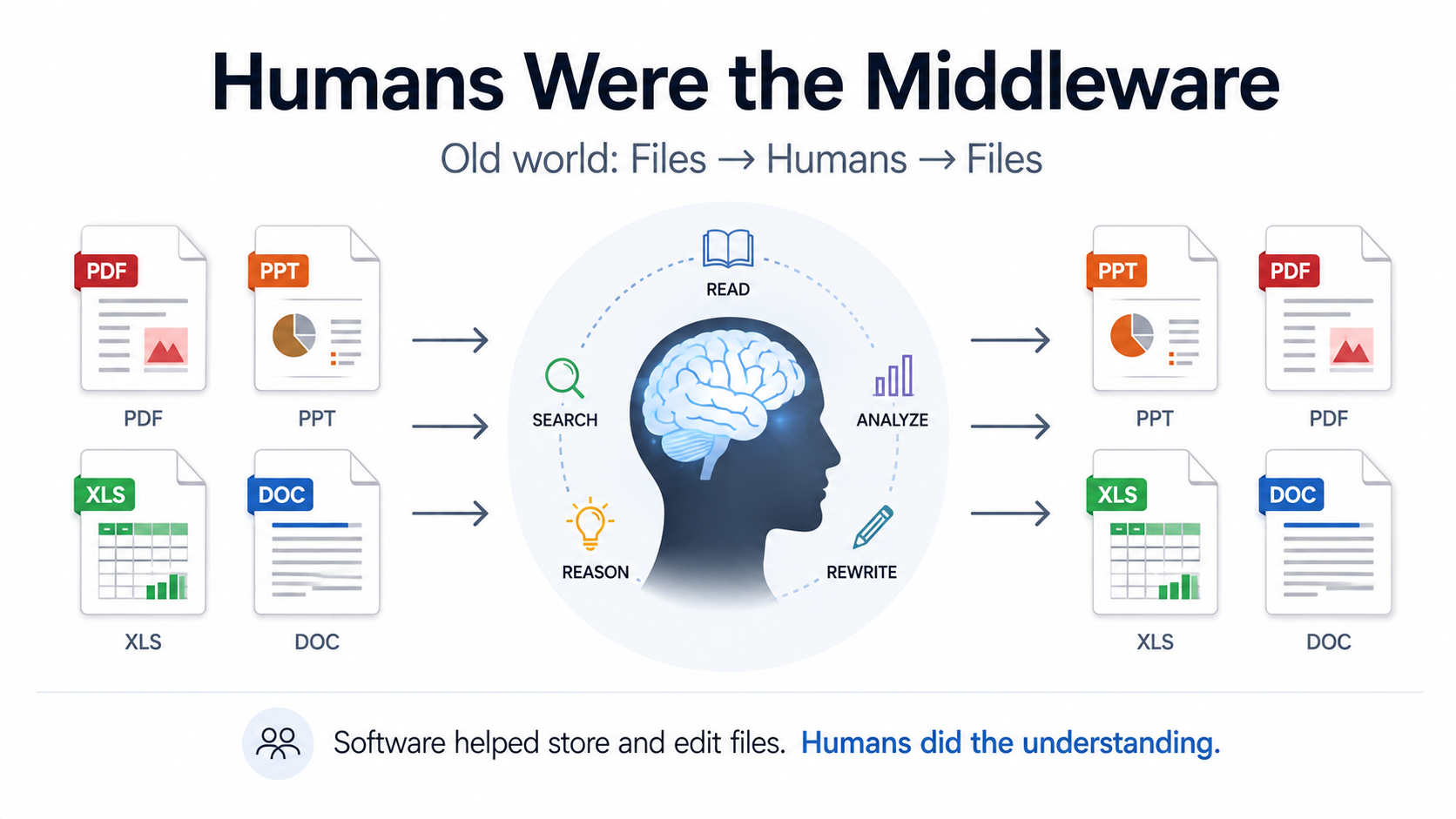
LLMs break on PDFs. More precisely, they break when the information they need is trapped in visual structure: charts, tables, financial reports, board decks, footnotes, page layouts, and scanned documents. Business professionals rarely work from clean text files. The knowledge that matters is usually inside PDFs, PPTs, receipts, forms, and messy enterprise document folders.
Why Plain OCR Is Not Enough
Traditional OCR was built to read text. That is necessary, but not sufficient for modern AI workflows. A due diligence agent, RAG system, or analyst copilot needs to know which numbers belong to which table headers, which chart series correspond to which year, how pages connect, where sections begin, and what context surrounds each extracted fact.
If a financial table collapses into flat text, the model may still receive the numbers, but it loses the relationships that make those numbers meaningful. If a chart is ignored, an entire argument in a presentation disappears. If page order is broken, retrieval and citation quality degrade downstream.
What Nebula Does
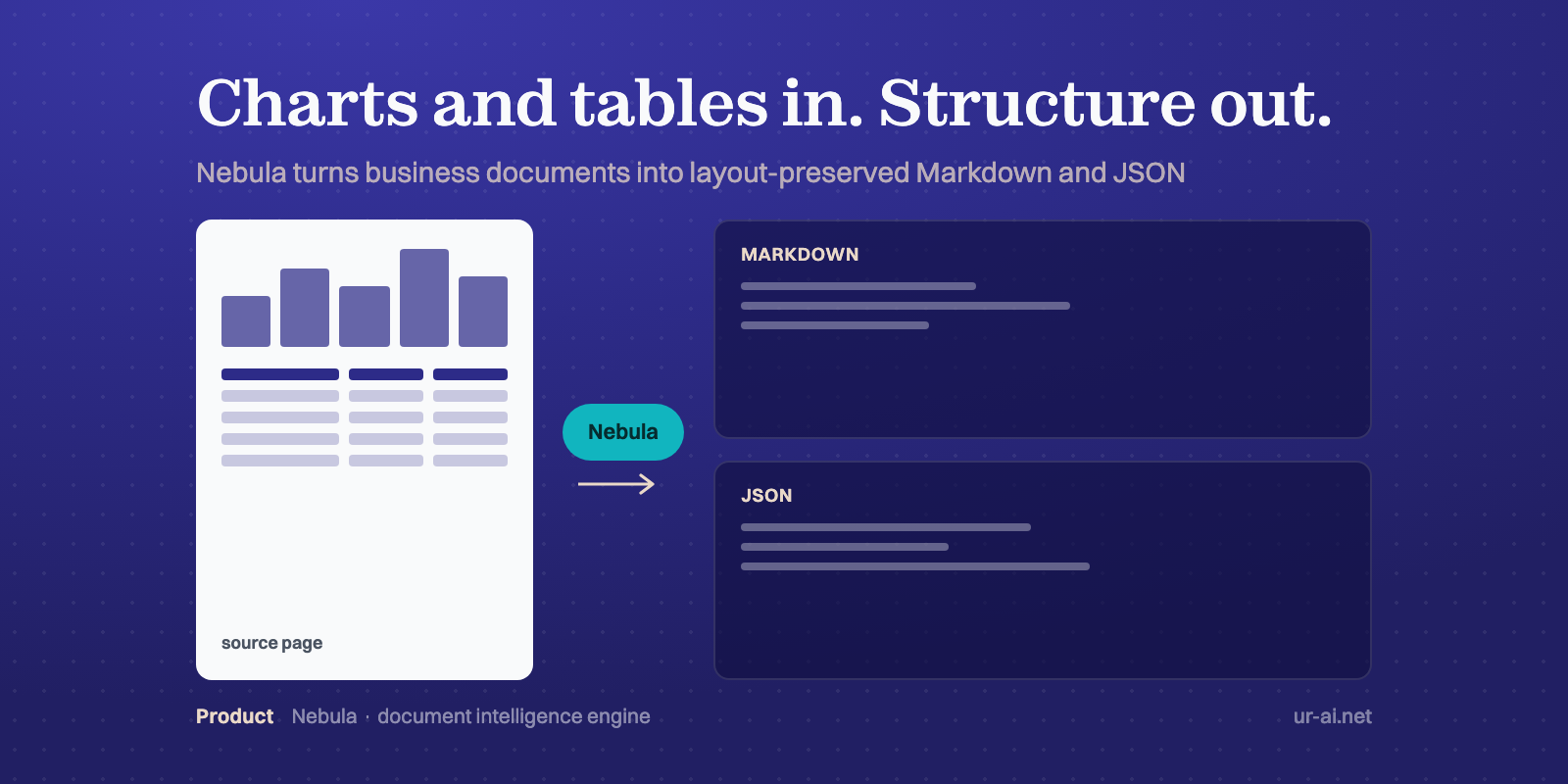
Nebula converts PDFs, common image formats, and PowerPoint files into structured Markdown for LLMs, RAG systems, agents, and human review. Users can upload a single file or folders of files, process documents asynchronously, download per-document Markdown, download structured batch outputs, or export a single combined Markdown artifact.
For live examples of source documents being converted into Markdown, visit the Nebula homepage and explore the interactive sample gallery.
- Expense and financial documents become cleaner Markdown for reconciliation and accounting workflows.
- Folders of PDFs and PPTs can be uploaded as batches while preserving file boundaries.
- Charts, tables, and page context are represented as structured output instead of discarded visual content.
- Combined Markdown exports make large document sets easier to feed into downstream GenAI pipelines.
Built from Our Due Diligence Work
We have been researching this problem deeply over the past year because it is critical to due diligence. Specter, our M&A due diligence platform, depends on reliable document transformation before any higher-level analysis can happen. If the input is broken, every downstream answer becomes fragile.
That is the core idea behind Nebula: structured input leads to significantly better output. We are not trying to make OCR look cleaner for its own sake. We are trying to make business documents usable by AI systems without losing the context that professionals rely on.
Enterprise-Grade and Auditable
Nebula routes to leading frontier vision-language models plus our own fine-tuned VLMs. Customer data is not used for training. The platform is designed for enterprise use cases where security, enterprise data controls, and auditability matter from the beginning.
Ur AI is ISO 27001:2022 certified, has completed a SOC 2 Type 2 examination, and is GDPR compliant. For teams exploring AI document processing in regulated or high-trust environments, those controls are not side details; they are part of the product surface.
Free Trial Until May 15
Nebula is available as a free trial until May 15, 2026. If PDFs, PPTs, charts, tables, or scanned business documents are part of your GenAI workflow, please try it with your own files and tell us where it works, where it fails, and what you need next.
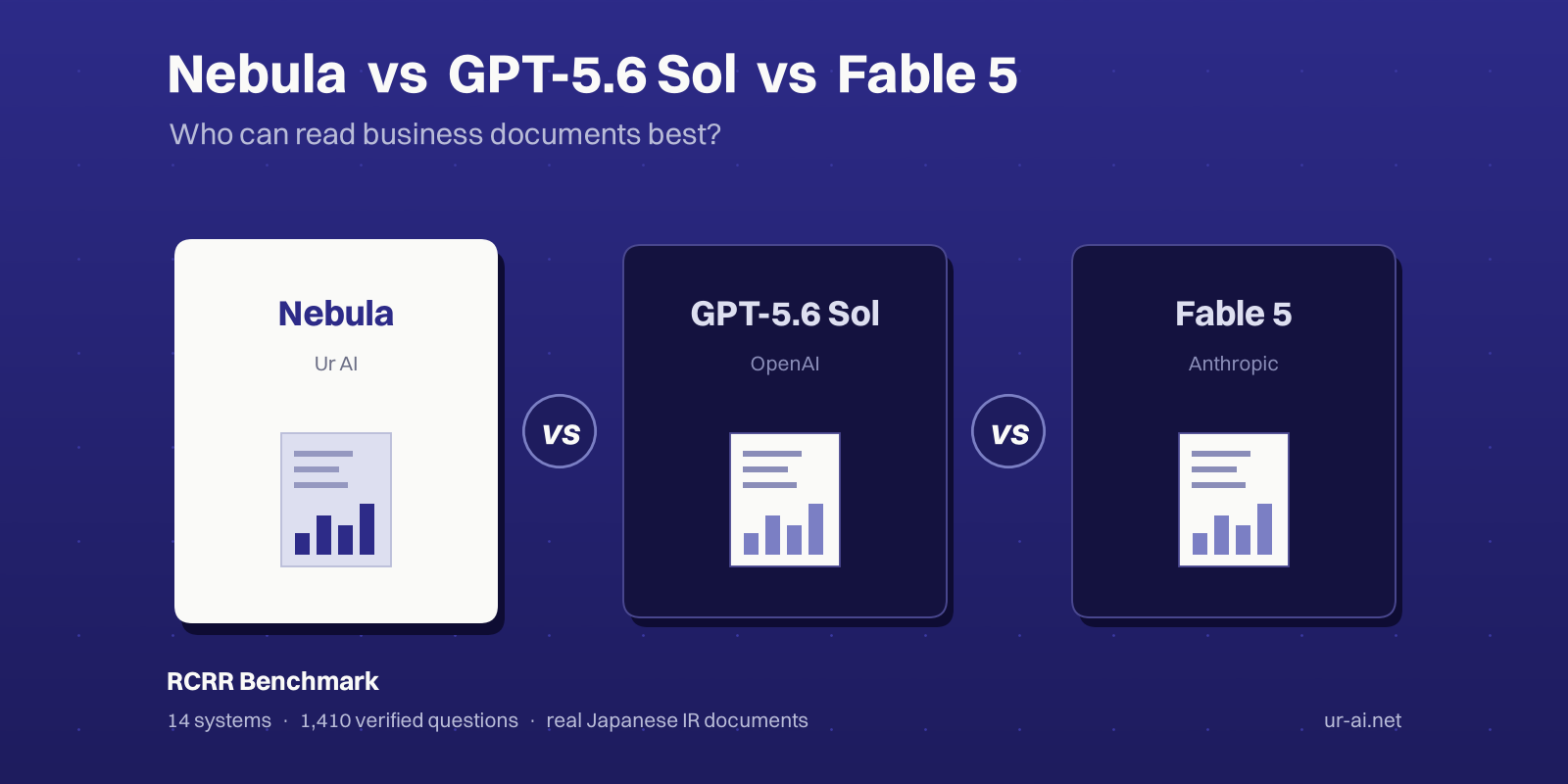
We will share more on Nebula benchmarking and model tuning soon. For now, the most useful feedback is practical: real documents, real workflows, and honest notes from teams trying to make LLMs work on business files.
Frequently Asked Questions
What is Nebula?
Nebula is Ur AI’s document intelligence platform for converting complex business documents into AI-ready Markdown. It is designed for LLM, RAG, agent, and due diligence workflows that need structure from PDFs, PowerPoint files, charts, tables, financial reports, and messy scans.
What file types and workflows does Nebula support?
Nebula supports PDFs, common image formats, and PowerPoint files. Users can upload a single document or folders of documents, process them asynchronously, download per-file Markdown, download structured batch outputs, or export a single combined Markdown file.
Why is structured Markdown better than plain OCR text for LLMs?
Plain OCR text often loses the table structure, chart context, page order, financial labels, and section hierarchy that LLMs need for reliable reasoning. Nebula preserves these relationships in Markdown and structured artifacts so downstream AI systems can answer questions from the document instead of guessing from flattened text.
Is customer data used for training?
No. Customer documents uploaded to Nebula are not used for training. Nebula is built for enterprise workflows with per-tenant isolation, access controls, and an Ur AI security posture that includes ISO 27001:2022 certification, a completed SOC 2 Type 2 examination, and GDPR compliance.
Is Nebula free to try?
Yes. The public initial release includes free trial access until May 15, 2026. We especially welcome feedback from teams using PDFs and presentations in GenAI, RAG, agent, or due diligence workflows.