Inside Specter: The Three Technical Pillars Behind Our Due Diligence Platform
What makes Specter different is not just AI — it is the proprietary technology stack we built around it. Here are the three pillars that power accurate, auditable due diligence.

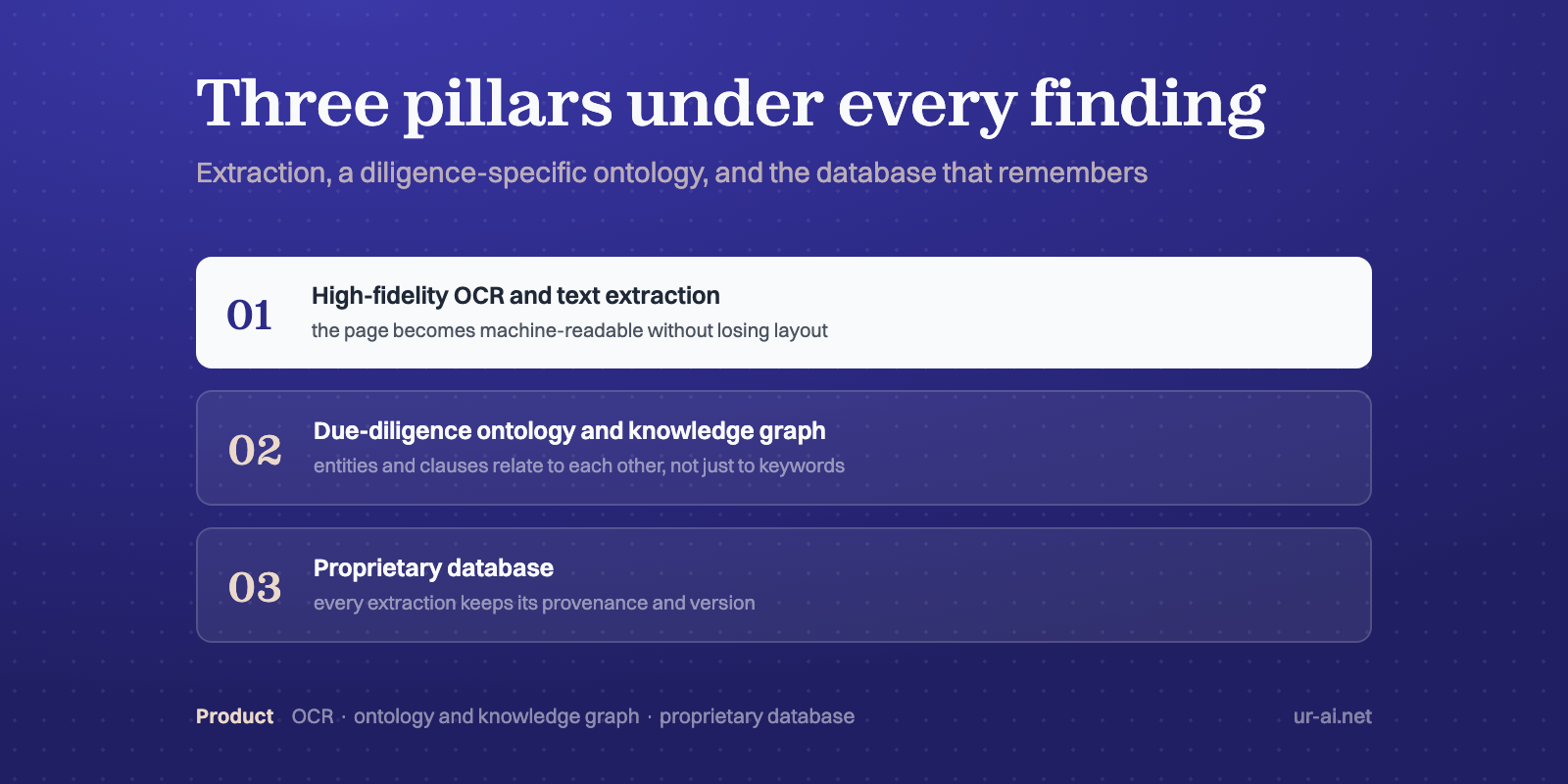
Specter is not just another AI wrapper. Behind the platform are three proprietary technical pillars that we have built specifically for due diligence: high-fidelity OCR and text extraction, a due diligence-specific ontology and knowledge graph, and a proprietary database covering 15+ countries. Together, these enable the accuracy, auditability, and depth that our customers rely on.
Pillar 1: High-Fidelity OCR and Text Extraction
Business documents — especially Japanese business documents — are built for human eyes, not AI. They contain complex tables, charts, images, and formatting conventions that general-purpose OCR tools struggle with. Japanese accounting formats like 月次決算 (monthly financial statements) use specific visual structures and conventions that require specialized handling.
Specter has custom-developed its own IP for extracting and converting this information into AI-friendly formats with high accuracy. Our OCR pipeline handles multi-column layouts, embedded charts, handwritten annotations, and scanned documents — converting them into structured data that our AI can analyze with confidence.
We are currently benchmarking our OCR pipeline against Gemini, Azure Document Intelligence, Docling, and LlamaParse. Our specialized approach consistently outperforms general-purpose solutions on Japanese business documents.
We have also secured a strategic partnership with an advanced next-generation GPU cluster provider in Japan to further strengthen and fine-tune a locally hosted model for document processing. This investment in Japan-based infrastructure ensures data sovereignty and low-latency processing for our Japanese enterprise customers.
Pillar 2: Due Diligence-Specific Ontology and Knowledge Graph
The second pillar underpins Specter's core philosophy of 100% auditability. We have built a knowledge graph and ontology layer specifically designed for due diligence workflows. This is not a generic knowledge base — it encodes the relationships, hierarchies, and dependencies that matter in deal analysis: corporate structures, regulatory frameworks, financial statement relationships, contractual obligations, and risk categorizations.
- Structured reasoning — The knowledge graph enables Specter to trace every finding back through a chain of evidence to specific source documents.
- Cross-document intelligence — Specter identifies connections across thousands of documents that human analysts might miss: a clause in one contract that contradicts a representation in another.
- Multilingual precision — The ontology includes specialized language support for our custom-trained languages (Japanese, English, Indonesian, Vietnamese, Spanish, Arabic) and general support for all other global languages.
- Regulatory awareness — The graph encodes jurisdiction-specific regulatory requirements, enabling Specter to flag compliance issues relevant to the specific deal geography.
Pillar 3: Proprietary Database
The third pillar is our proprietary database covering 15+ countries. This database contains thousands of industry reports, regulations, and government publications — legal, tax, financial, and sector-specific — that provide the contextual foundation for Specter's analysis.
When Specter analyzes a data room, it does not operate in isolation. It cross-references findings against this curated body of regulatory and industry knowledge, identifying risks and opportunities that would otherwise require days of manual desk research. This is particularly valuable for cross-border transactions, where understanding local regulations and market dynamics is critical.
Specter is not just analyzing what is in the data room. It is contextualizing those findings against a curated body of regulatory and industry knowledge spanning 15+ countries.
Why These Pillars Matter
Any company can integrate a large language model and call it an AI product. What differentiates Specter is the proprietary technology stack we have built around AI: the OCR pipeline that handles the messiest real-world documents, the knowledge graph that ensures every insight is auditable, and the database that provides the contextual depth that deal teams need.
These three pillars are the product of deep domain expertise — built by people who understand both the engineering challenges and the real-world demands of due diligence. They are why Specter can deliver 100% auditability, not as a marketing claim, but as an architectural guarantee.
Frequently Asked Questions
What technology powers Specter's due diligence platform?
Specter is built on three proprietary technical pillars: (1) High-fidelity OCR and text extraction that converts complex business documents — including Japanese accounting formats, charts, and tables — into AI-friendly formats; (2) A due diligence-specific ontology and knowledge graph that underpins 100% auditability with specialized multi-language support; (3) A proprietary database covering 15+ countries with thousands of industry reports and government regulations.
How does Specter handle complex Japanese business documents?
Specter has custom-developed its own IP for high-fidelity OCR and text extraction specifically designed for Japanese business documents. These documents often contain complex tables, charts, and images built for the human eye or specific accounting conventions such as the 月次決算 format. Specter converts this information into AI-friendly formats with high accuracy, outperforming general-purpose OCR solutions.