Ur AI Achieves SOC 2 Type 2 and GDPR Compliance: What Those Words Actually Prove
Ur AI has completed its SOC 2 Type 2 examination and its GDPR compliance program, joining the ISO 27001:2022 certification we received in January. What each framework proves, what none of them prove, and how to check any AI vendor for yourself.

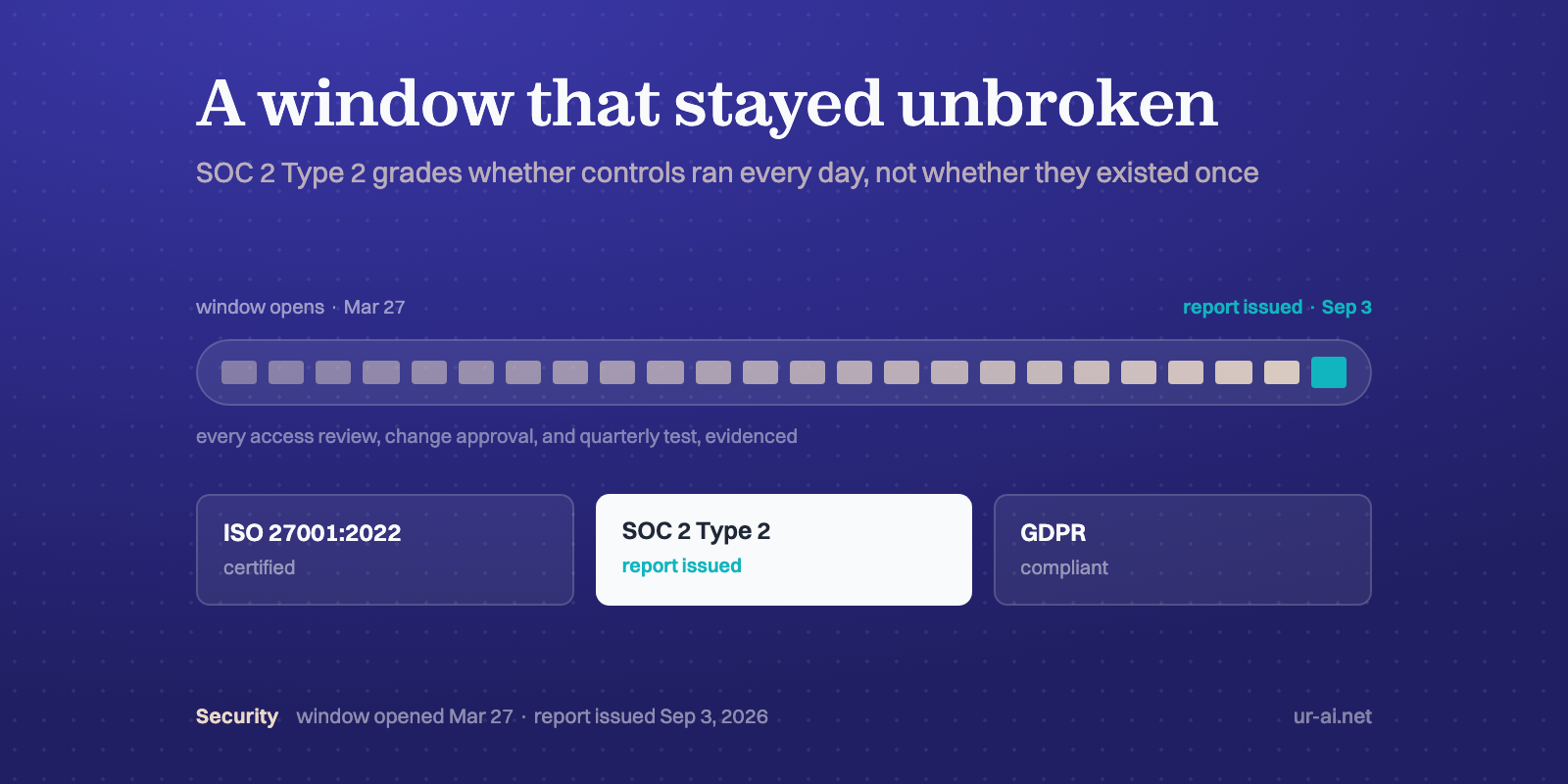
As of September 3, 2026, Ur AI has completed its SOC 2 Type 2 examination and its GDPR compliance program. Together with the ISO 27001:2022 certification we received in January 2026, enterprise buyers can now verify three separate things about us: that we operate a certified information security management system, that an independent examination covered a multi-month window rather than a single day, and that our handling of personal data is governed by published policies. The SOC 2 Type 2 report and the ISO 27001:2022 certificate are both available on request at trust.ur-ai.net, next to the 75 controls we monitor continuously and the full list of every subprocessor that touches customer data.
Readiness work began in February. The observation window opened on March 27, 2026, and from that day every access review, every change approval, every offboarding checklist, and every quarterly test became evidence that either existed or did not. Evidence cannot be backfilled, and six months is a long time to be graded on consistency.
What SOC 2 Type 2 actually proves (and what it does not)
A SOC 2 report is an attestation, not a certificate. It is an examination performed by a licensed CPA firm against the AICPA's Trust Services Criteria, which cover five categories: security, availability, processing integrity, confidentiality, and privacy. Nobody hands out a SOC 2 badge. What exists is a report.
The difference between the two report types is time. A Type 1 asks whether controls were suitably designed on a given date. A Type 2 asks whether those same controls operated effectively across a defined observation window, typically six to twelve months. A control that is designed well in March and quietly stops running in June does not survive a Type 2. It appears in the report as an exception, in writing, for every customer to read.
A Type 1 asks whether you built the thing. A Type 2 asks whether you lived with it.
The company being examined chooses its own scope. Vendors rarely volunteer that, and it means two SOC 2 reports can describe very different amounts of work. When you receive one, four things determine what it is worth: which trust services categories were in scope, how long the observation window ran, whether the auditor noted any exceptions, and which subservice organizations were carved out. A logo on a website tells you none of that. Ask for the report.
Three frameworks, three different claims
| Framework | What it is | Who issues it | What it demonstrates |
|---|---|---|---|
| ISO/IEC 27001:2022 | Certification of an information security management system | An accredited certification body (ours was Bureau Veritas Japan) | That a documented management system for security exists and is audited on a recurring cycle |
| SOC 2 Type 1 | Attestation report | A licensed CPA firm | That controls were suitably designed as of one specific date |
| SOC 2 Type 2 | Attestation report | A licensed CPA firm | That controls operated effectively throughout a defined observation window |
| GDPR | EU regulation on the protection of personal data | Not applicable — it is law. Article 42 provides for voluntary certification mechanisms, but none covers an organization as a whole | That the policies, procedures and records required to protect personal data are in place and operating |
The three are complementary rather than interchangeable. ISO 27001 describes the management system, SOC 2 Type 2 evidences its operation over time, and GDPR governs personal data specifically.
What GDPR compliance means when your software reads documents
GDPR is European law rather than a certification scheme. Article 42 provides for voluntary certification mechanisms, but no single certificate establishes an organization as compliant with the GDPR as a whole — compliance is demonstrated through documented obligations. So when a vendor says they are GDPR compliant, ask to see the policies, the records, and the subprocessor list.
Three articles carry most of the practical weight. Article 32 requires appropriate technical and organisational measures, and names encryption, ongoing confidentiality and resilience, restoration of access after an incident, and regular testing of whether those measures actually work. Article 28 governs processors: a processor may act only on documented instructions, must have authorisation before engaging a sub-processor, must impose the same obligations on that sub-processor, and remains fully liable if the sub-processor fails. Article 83 sets the ceiling for getting this wrong at 20 million euros or four percent of total worldwide annual turnover, whichever is higher.
The European Commission has adopted an adequacy decision for Japan, so personal data can flow from the EEA to Japan without additional transfer safeguards. For a Tokyo company with a documented GDPR program, that removes a step European counterparties usually expect to negotiate.
A document intelligence engine sees whatever is inside the file. A construction submittal carries names and professional stamps. A logistics manifest carries driver details. A retail supply agreement carries signatories. An HR folder is personal data end to end. You do not get to decide in advance that a workload contains no personal data, which is why the Article 32 measures have to be properties of the product: encryption at rest for the datastores, encrypted transmission over public networks, privileged access restricted to a business need, and deletion that actually happens when a customer leaves.
You cannot promise a document parser will never see personal data. You can only build it as though it always will.
What the program actually took
We run continuous control monitoring through Vanta, which is why our trust center shows a live status rather than a PDF from last year. Seventy-five controls are monitored, grouped into five areas.
75 monitored controls, by area
| Control area | Controls | Examples |
|---|---|---|
| Internal security procedures | 35 | Change management, SDLC, configuration management, continuity testing, board oversight |
| Infrastructure security | 21 | Unique production authentication, restricted database and firewall access, revocation on termination |
| Organizational security | 11 | Background checks, confidentiality agreements, security awareness training, password policy |
| Product security | 5 | Encryption at rest, encrypted transmission, vulnerability monitoring, annual penetration testing |
| Data and privacy | 3 | Data classification, retention and disposal, customer data deleted on exit |
Live status for every control is published at trust.ur-ai.net.
Underneath the controls sit the documents. Eight data protection policies were written, approved, and published: Information Security, Access Control, Cryptography, Data Management, GDPR Compliance, GDPR Incident Response, Business Continuity and Disaster Recovery, and our Privacy Policy. Each one has to be more than a file. Access Control means access reviews and termination checklists completed inside an agreed SLA. Business Continuity means the plan is tested annually, not written annually.
- Security awareness training completed within thirty days of hire and at least annually after that, for every employee
- Background checks and signed confidentiality agreements for employees, with the code of conduct extended to contractors
- Every production change authorized, documented, tested, reviewed, and approved before it shipped
- Access to production systems, databases, firewalls, and deployment restricted to a business need, and revoked inside an SLA at termination
- Penetration testing at least annually, with remediation tracked against agreed SLAs
- Business continuity and disaster recovery plans tested, not merely maintained
- Annual control self-assessments, plus a board briefing on cybersecurity and privacy risk
- Nine subprocessors reviewed and published, from cloud and version control through to the model providers
Designing a control is the easy part. The hard part is keeping it running for months while the product ships, the team grows, and the infrastructure changes underneath it. There were weeks when the compliance backlog competed directly with the product backlog, and the compliance backlog won.
Why this matters more for AI vendors than for ordinary software
Most enterprise software holds records that someone already classified: a customer row, an order, a support ticket. Document AI is different. It ingests raw files that nobody triaged first, and it passes their contents to models. That changes which questions are worth asking, starting with which subprocessors see the file.
- Are my documents used to train models, including by any model provider you route to? Get the answer in writing, then check it against the published subprocessor list.
- Which subprocessors process my data, and where do they operate? A vendor that will not publish that list cannot satisfy Article 28 for a European counterparty.
- What is deleted when I leave, and how would you prove it? Deletion on exit should be a monitored control, not a support ticket.
- Can I have the SOC 2 report rather than the badge? The badge is artwork. The report carries the scope, the observation window, and any exceptions.
What you can verify today
Our trust center at trust.ur-ai.net publishes the frameworks we hold, the live status of all 75 controls, the eight data protection policies, and every subprocessor we use. The ISO 27001:2022 certificate and the SOC 2 Type 2 report are both available there on request.
Inside the products, these controls line up with commitments we had already made. Nebula, our document intelligence engine, keeps per-tenant data isolation, authenticates with per-customer API keys, records a per-job audit trail, and does not use customer documents to train models. Specter, which is built on top of Nebula, cites every finding back to its source page so a reviewer can check the reasoning instead of trusting it. Compliance frameworks show that a vendor operates carefully. Traceable outputs let a construction team, a logistics operator, or an investment committee defend a decision months later.
Certifications tell you a vendor is careful with your documents. Auditability tells you whether you can defend the decision you made from them.
A SOC 2 Type 2 report always describes a window that has already closed. The next one opened the day this one ended, and the control status stays live at trust.ur-ai.net in between.
Ur AI is ISO 27001:2022 certified, has completed a SOC 2 Type 2 examination, and operates a documented GDPR compliance program. Request the report, the certificate, or a security review at trust.ur-ai.net.
Sources
- AICPA & CIMA: 2017 Trust Services Criteria (revised points of focus, 2022) ↗
- AICPA & CIMA: SOC 2 for Service Organizations ↗
- GDPR Article 32: Security of processing ↗
- GDPR Article 28: Processor ↗
- GDPR Article 83: General conditions for imposing administrative fines ↗
- European Commission: Adequacy decisions (Japan) ↗
- Ur AI Trust Center ↗
Frequently Asked Questions
Is Ur AI SOC 2 compliant?
Yes. Ur AI completed its SOC 2 Type 2 examination in September 2026, following an observation window that opened on March 27, 2026. Ur AI has also held ISO/IEC 27001:2022 certification since January 2026 and operates a documented GDPR compliance program. The SOC 2 Type 2 report and the ISO 27001:2022 certificate are both available on request at trust.ur-ai.net, alongside the live status of 75 monitored controls and the full subprocessor list.
What is the difference between SOC 2 Type 1 and SOC 2 Type 2?
A SOC 2 Type 1 report evaluates whether a service organization's controls were suitably designed as of a single date. A SOC 2 Type 2 report evaluates whether those same controls also operated effectively across a defined observation window, typically six to twelve months. Type 2 is the stronger evidence, because it shows sustained operation rather than a point-in-time snapshot, and any control that lapsed during the window is recorded in the report as an exception.
Is there such a thing as GDPR certification?
The GDPR provides for voluntary certification mechanisms under Article 42. However, there is no single certificate that establishes an organization's compliance with the GDPR as a whole. Compliance should also be assessed through documented policies, the lawful basis for processing activities, Article 32 security measures, Article 28 subprocessor management, and working procedures for data subject requests and personal data breaches. When a vendor claims GDPR compliance, organizations should review this documentation and the vendor's actual operating practices, rather than relying on certification alone.
What should organizations check before adopting an AI service?
Organizations should check four things. First, whether their documents are used to train AI models, including by any model providers used by the service. Second, which subprocessors process their data and where those subprocessors operate. Third, what data is deleted when they stop using the service and how that deletion can be verified. Fourth, whether they can review the actual SOC 2 report rather than only a badge — the report contains the scope, observation period, and any recorded exceptions.