Where Is Enterprise AI Headed? From Files to Machine-Native Information Systems
Enterprise AI is moving beyond isolated model features toward information systems that can preserve meaning, choose the right evidence, govern agent actions, and improve through measurable feedback loops.

Enterprise AI is heading from isolated model features toward machine-native information systems. The important shift is not simply from one generation of models to another. It is from software that waits for people to interpret files toward systems that can preserve meaning, select evidence, reason within defined boundaries, take controlled actions, and learn from measured outcomes. Agents will increasingly coordinate this work, but dependable autonomy will come from the quality of the surrounding information pipeline, not from the agent label alone.
This view changes the central enterprise question. Instead of asking only which model performs best, organizations have to ask how information enters the system, what structure survives conversion, how a question determines the access path, who or what has authority to act, and where a failure can be found. Models remain important, but they are one component in a larger operating system for knowledge.
Humans were the integration layer
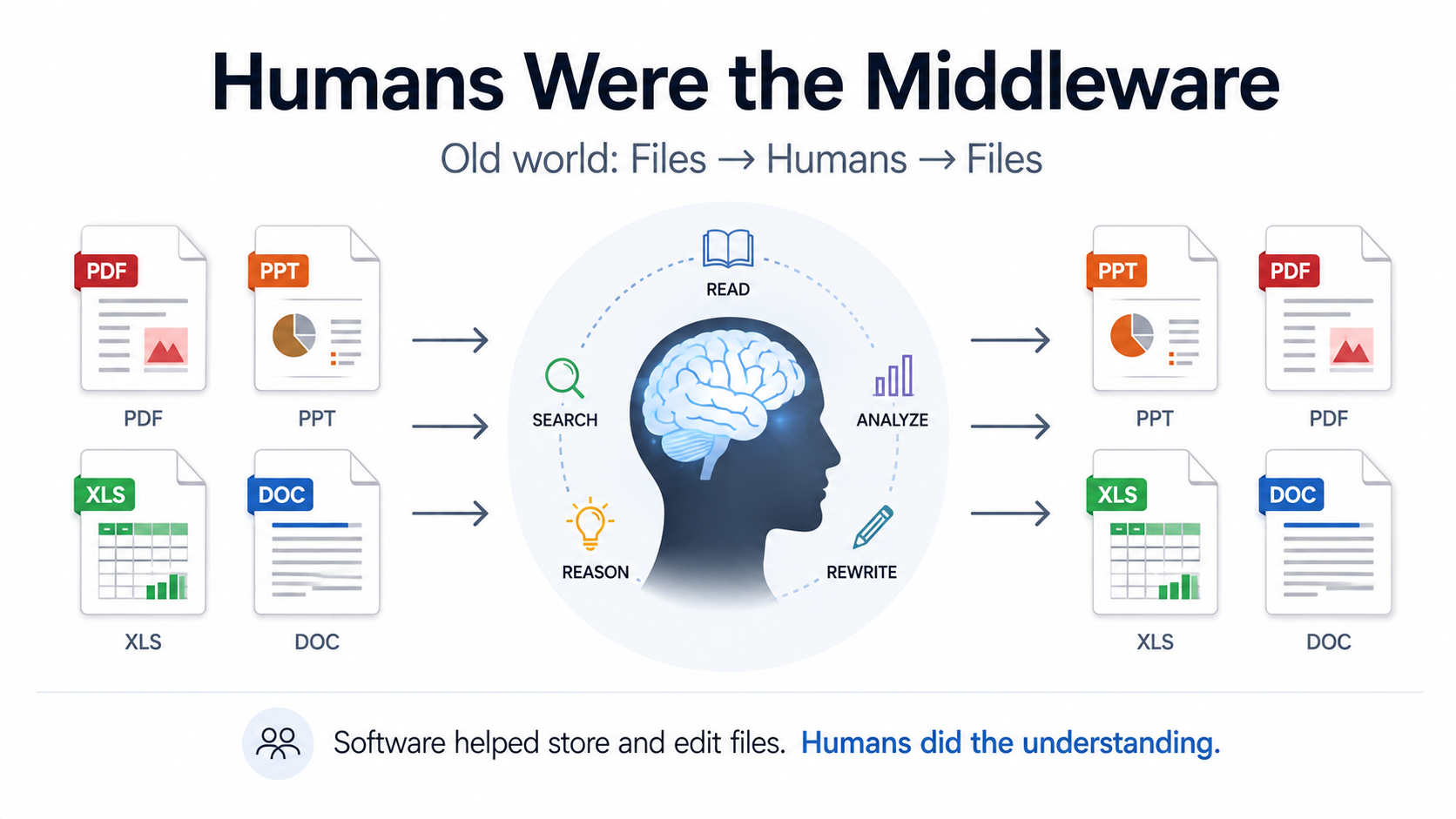
For decades, business software was designed primarily to create, store, transmit, and edit files. A PDF carried a report, a spreadsheet carried calculations, a presentation carried a narrative, and an email carried context. The connections among them usually lived in a person’s head. People searched for the right material, interpreted layouts, reconciled definitions, judged which source was current, and translated the result into the next file or application.
That arrangement made humans the middleware. It was flexible because people could resolve ambiguity, but it was also difficult to scale, inspect, or reproduce. When an answer was wrong, the cause might have been an old attachment, a misunderstood chart, an unstated exception, or an incorrect calculation. The reasoning path rarely existed as a machine-readable record. Enterprise AI changes which parts of that path can be represented and operated by software. It does not remove human judgment; it makes the transformations around that judgment more explicit.
The transition is not from people to machines. It is from implicit, person-carried transformations to explicit, inspectable information operations.
The unit of AI shifts from model to system
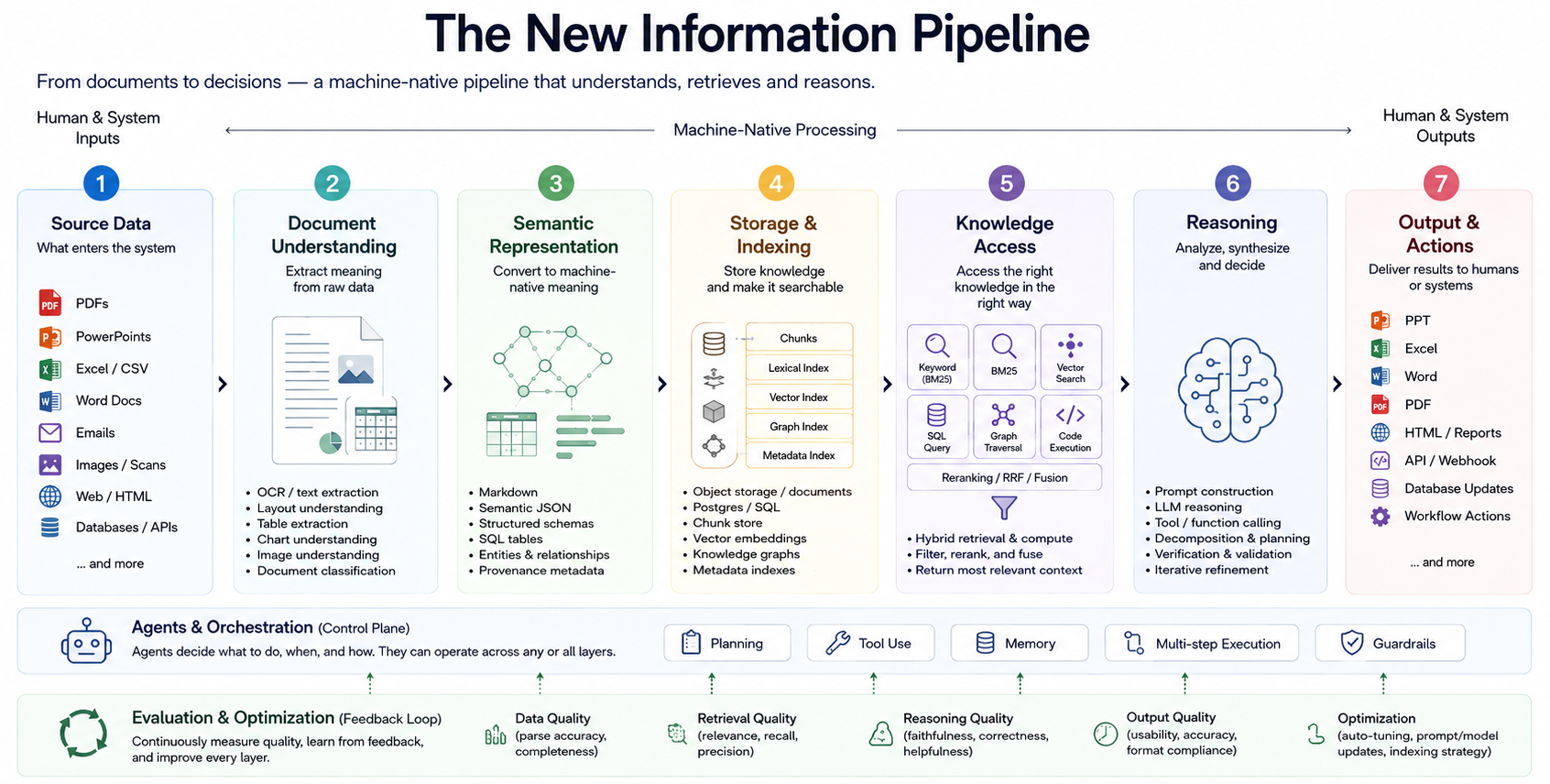
A useful enterprise architecture separates seven stages: source data, document understanding, semantic representation, storage and indexing, knowledge access, reasoning, and outputs or actions. The separation matters because an impressive answer can still rest on a damaged chain. A parser can lose a table hierarchy. A representation can detach a number from its label. An index can omit relevant evidence. Retrieval can choose a semantically similar but legally different clause. Reasoning can make an unsupported inference. An action can exceed the authority granted to the system.
Knowledge access also becomes more than search. The question determines the appropriate operation. Exact wording, conceptual similarity, quantitative analysis, relationship traversal, and transformation are different tasks. Treating every task as vector retrieval forces unlike questions through one mechanism and hides where precision was lost.
Different questions require different access paths
| Question pattern | Likely access path | Why |
|---|---|---|
| Find an exact clause | Exact match or BM25 | Preserves literal wording and defined terms |
| Find conceptually similar risks | Vector search | Matches meaning across different phrasing |
| Calculate a financial metric | SQL or code | Uses typed values and reproducible operations |
| Trace an ownership chain | Graph traversal | Preserves entities and relationships |
| Normalize or transform data | Code execution | Applies explicit, testable logic |
A planner may combine several paths, then rerank or reconcile the results before reasoning begins.
The practical consequence is that retrieval is becoming computation. A system may plan a route, run exact and semantic searches, query structured data, traverse relationships, execute a calculation, and fuse the results into grounded context. This is less like searching a library and more like compiling an evidence package for a specific decision. The quality of that package places an upper bound on the quality of the answer.
Agents become a control plane, not the whole stack
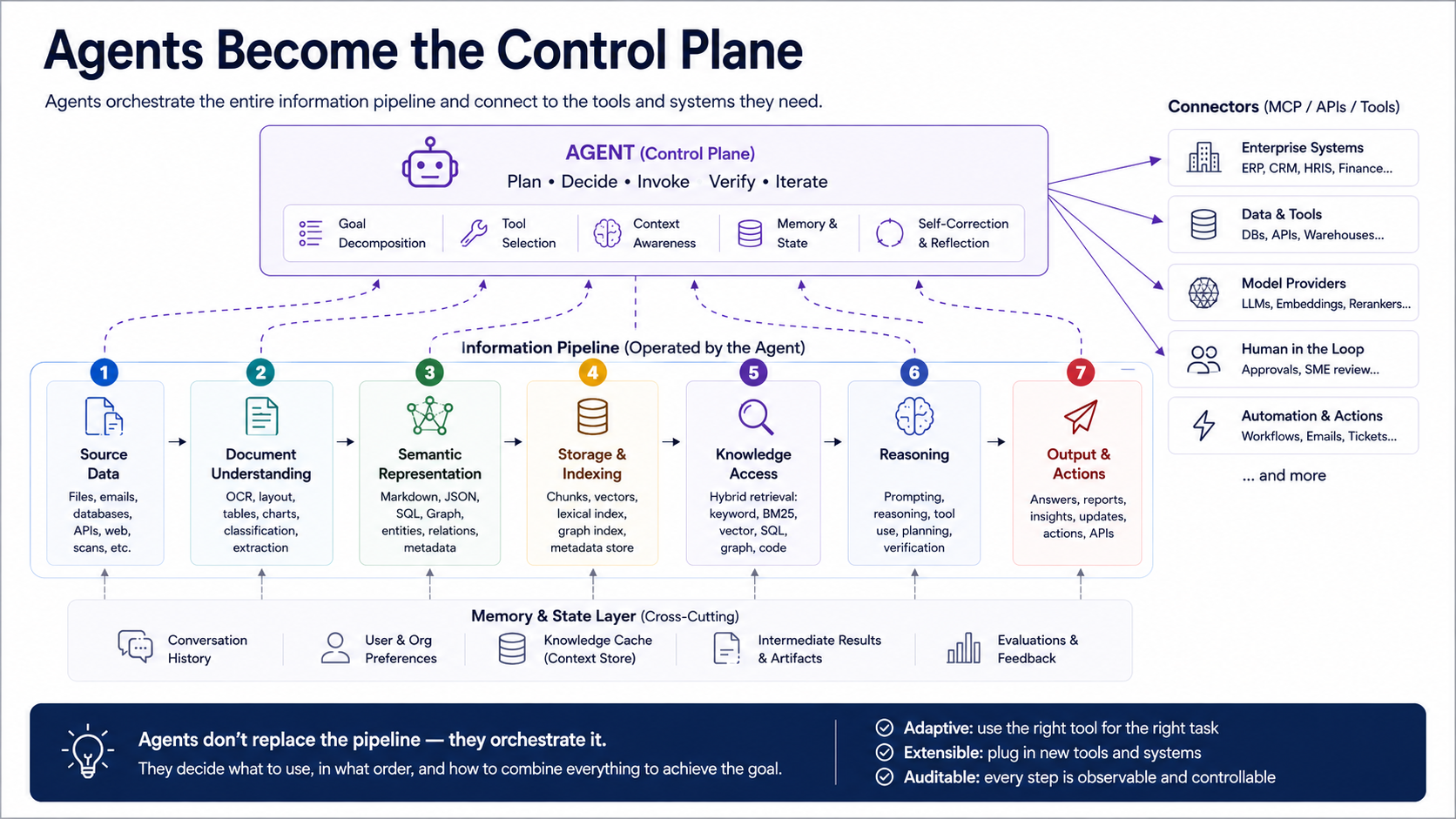
In this architecture, an agent acts as a control plane. It decomposes a goal, chooses tools, assembles context, maintains state, verifies intermediate results, and decides whether to continue, stop, or ask for help. A workflow follows a predefined path, while an agent can choose its process dynamically within the authority and tools it has been given. Anthropic describes this distinction and recommends starting with simple, composable patterns because added autonomy commonly adds cost and latency as well as flexibility.[1]
Autonomy is therefore a span, not a binary setting. One system may use a model only to rewrite text. Another may select among retrieval methods. A more autonomous system may plan and execute across the entire pipeline. Each broader span increases the need for identity, authorization, audit trails, observable tool calls, stop conditions, and human escalation. NIST’s current agent work emphasizes interoperability and security,[2] and its identity and authority work highlights identification, authorization, auditing, non-repudiation, and exposure to prompt injection when agents interact with diverse data and tools.[3]
Why coding agents are the misleading comparison
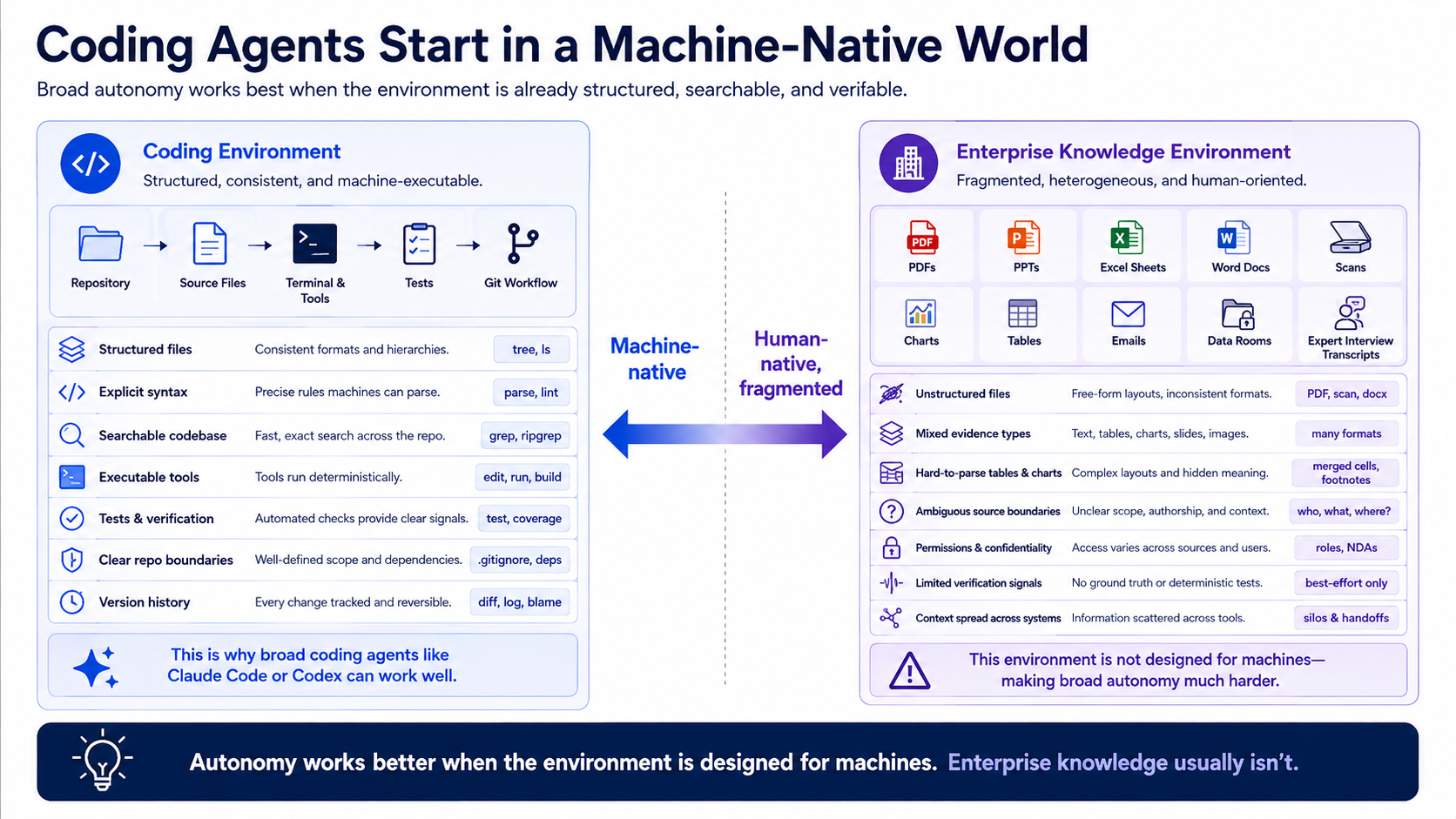
Coding agents offer a persuasive demonstration of broad autonomy, but software repositories are unusually machine-native environments. Files have explicit syntax and stable hierarchies. Search is fast and exact. Tools can run deterministically. Tests provide immediate signals. Repository boundaries limit scope, and version history makes changes traceable and reversible. The environment already contains a representation layer, an execution layer, an evaluation system, and a recovery mechanism.
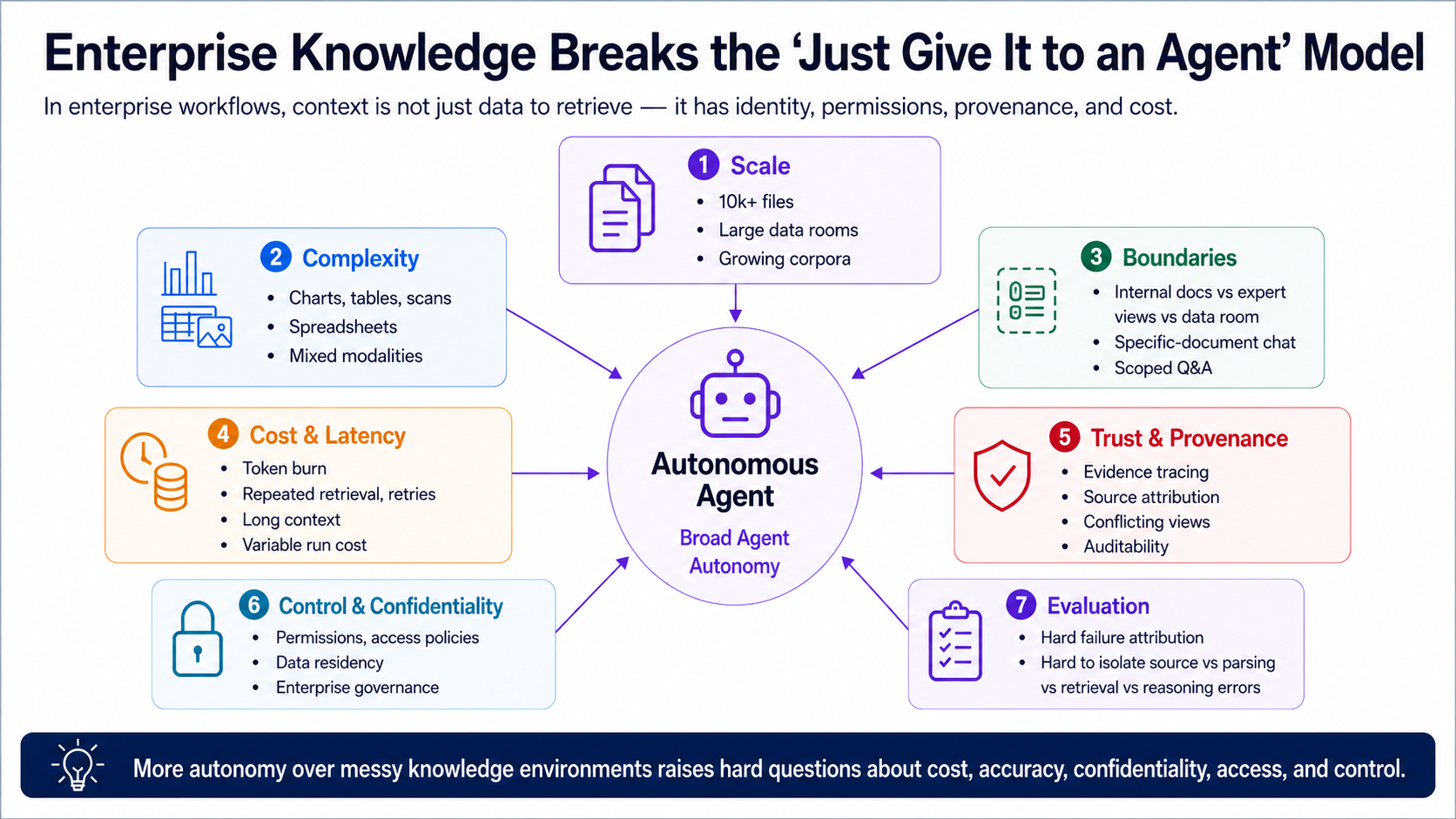
Enterprise knowledge is different. It is fragmented across documents, applications, databases, data rooms, scans, messages, and expert conversations. The same term may have different meanings across teams. A chart may encode a relationship visually that disappears when its text is extracted. Access depends on the user, source, purpose, geography, and time. There may be no deterministic test for whether a synthesis is complete. Broad autonomy over this environment has to address nine operating constraints explicitly:
- Scale: large and continuously changing collections make repeated full-context processing impractical.
- Heterogeneous formats: text, tables, charts, scans, spreadsheets, and application records preserve meaning in different ways.
- Semantic boundaries: the same words can refer to different entities, periods, definitions, or scopes.
- Permission boundaries: evidence and actions must remain limited to the authority of the user and system.
- Cost and latency: parsing, retrieval, long context, tool calls, and retries create variable run economics.
- Provenance and auditability: claims need traceable evidence, source identity, transformation history, and reviewable decisions.
- Control and confidentiality: governance, data residency, access policy, and safe action limits must hold throughout the run.
- Failure localization: operators need to distinguish source, parsing, representation, indexing, retrieval, reasoning, and action errors.
- Evaluation: quality must be tested over complete tasks, edge cases, changing data, and repeated runs.
These constraints are not arguments against agents. They explain why agent performance cannot be separated from information architecture and operating controls. Giving a capable model more tools does not resolve an ambiguous source boundary or restore a relationship that was lost during conversion.
One broken relationship can survive every downstream step
A financial waterfall chart provides a compact example. The question is: among the drivers of the FY2026 first-half business-profit variance, which item has the largest negative impact? In the original chart, the largest top-level negative driver is fixed costs at ▲32. Price/MIX is a separate top-level step with a total effect of ▲1, and a price callout of ▲23 is only one component inside that step.[4]
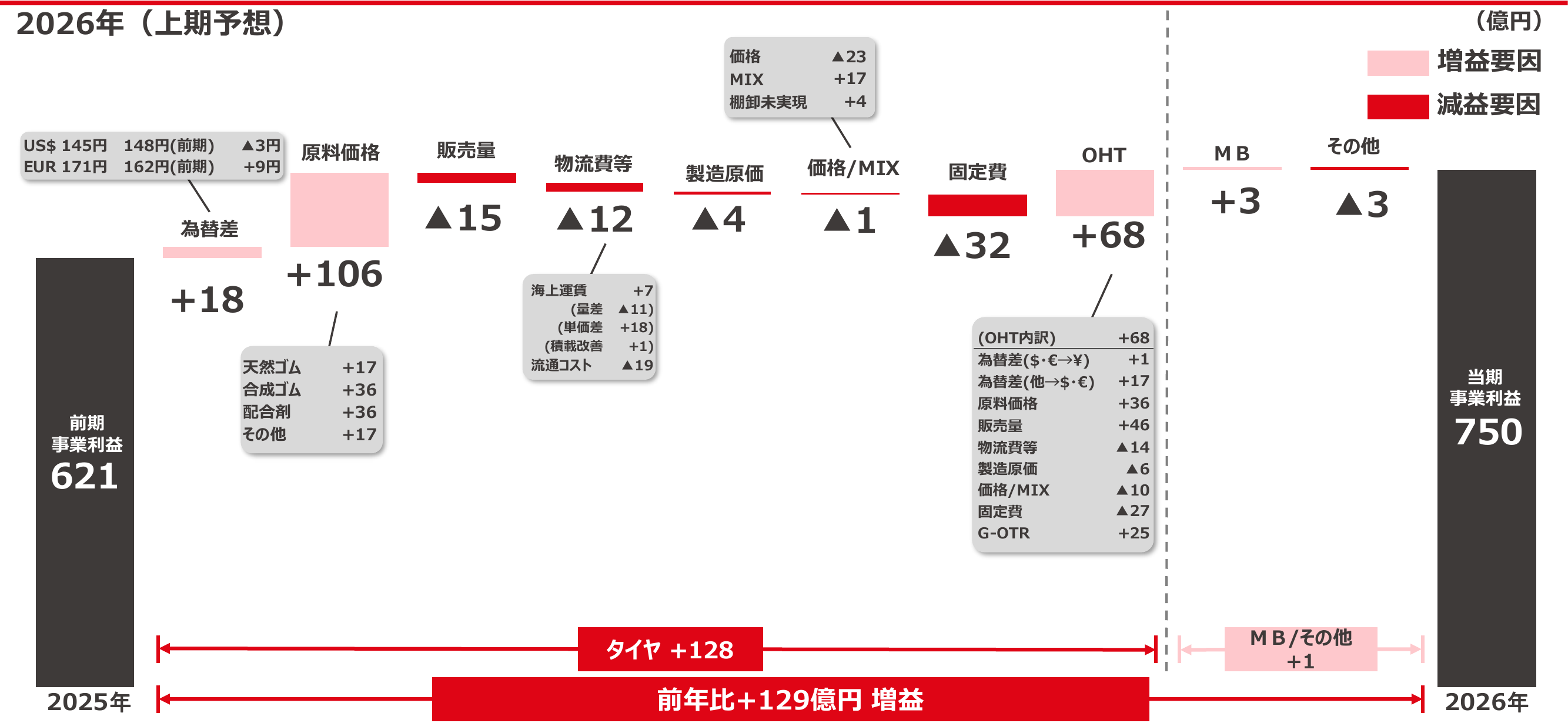
If conversion flattens the chart into disconnected text, retrieval can surface price ▲23 without the parent-child relationship that identifies it as a component of price/MIX ▲1. The reasoning model may then compare ▲23 with other retrieved values and confidently answer that price had the largest negative impact. The prose can be fluent, the arithmetic can be internally consistent, and the answer can still be wrong because the representation changed the question being answered.
The error propagates cleanly through every downstream stage: the source is correct, conversion loses hierarchy, retrieval returns the detached component, reasoning treats it as a peer, and the output presents the result. More reasoning at the final stage cannot reliably recover a relationship that is no longer present in the evidence. This is why document understanding and semantic representation are not preprocessing details. They are part of the reasoning system.
A polished answer is not evidence of a sound pipeline. The system must preserve the relationships that make each value, clause, and claim mean what it meant in the source.
The pipeline has to become a feedback loop
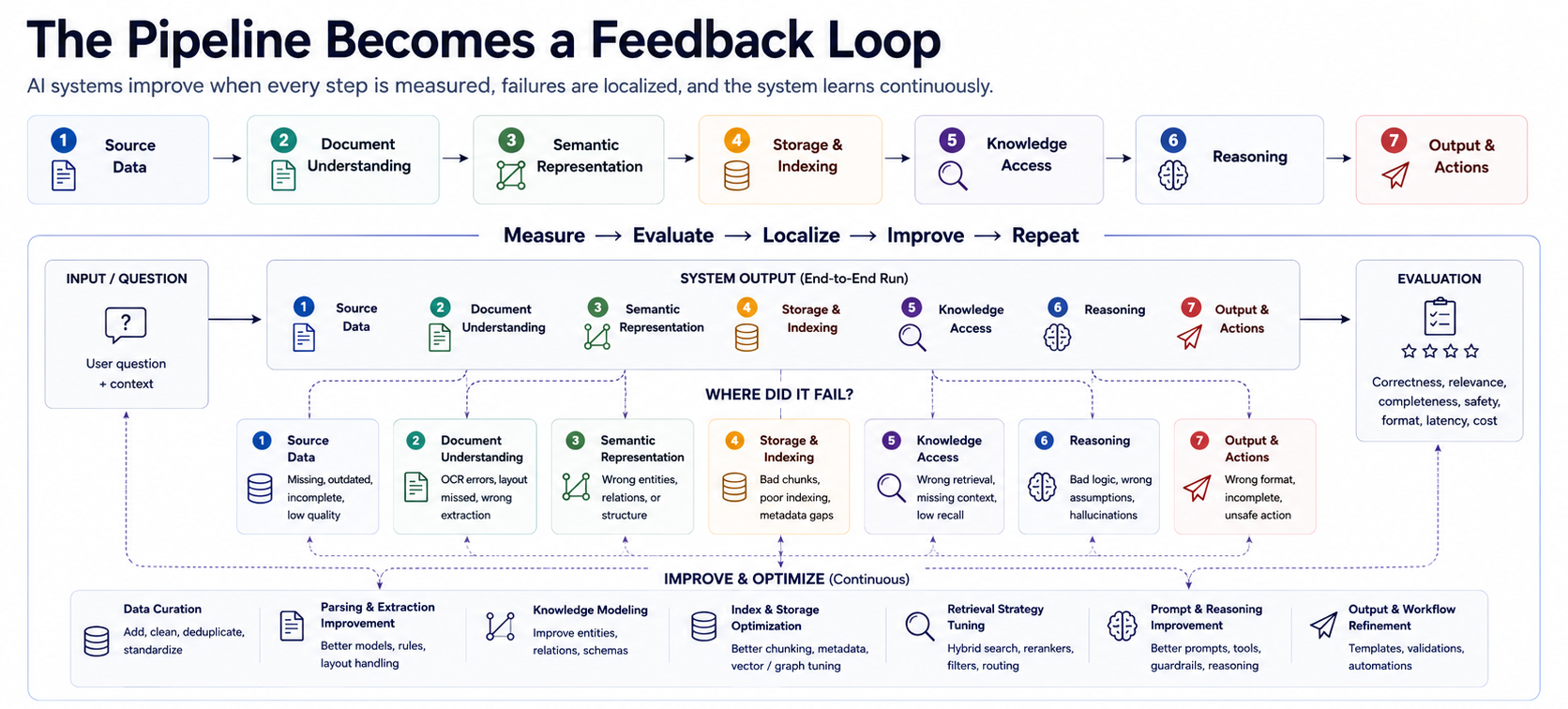
A dependable system measures the final task and retains enough intermediate evidence to locate the cause of failure. Source problems require curation. Parsing problems require better extraction or layout handling. Representation failures require better schemas and relationship models. Retrieval failures require different indexes, routing, filters, or reranking. Reasoning failures require better instructions, tools, validation, or escalation. Output failures require format checks and action controls. Treating every bad result as a prompt problem prevents systematic improvement.
NIST’s AI Risk Management Framework calls for systems to define their context, document human oversight, test in conditions similar to deployment, monitor behavior in production, support fail-safe behavior, and use independent review where appropriate.[5] Agent evaluation adds another complication: tasks are multi-turn and stateful, so teams need to examine the trajectory as well as the final answer and track cost, latency, tool errors, and regressions across repeated trials.[6]
Provenance is the connective tissue. A claim should remain linked to its source, the transformations applied to it, and the activity that produced the result. W3C’s PROV-O provides a general model for representing and exchanging this kind of provenance across systems.[7] In enterprise use, that history supports review, correction, accountability, and selective reuse.
Outputs become reusable, not only readable
The final shift concerns output. Today, an AI workflow often produces a PDF, slide deck, spreadsheet, or message for a person. The next workflow then has to parse that artifact again, paying another cost and risking another loss of structure. A machine-native system can produce a human interface and a structured representation together. One is readable and interactive; the other is semantic, queryable, permission-aware, and reusable. Meaning and provenance can persist across loops instead of being reconstructed each time.
The direction of enterprise AI is not simply toward more autonomous models. It is toward information systems in which autonomy can be bounded, evidence can be traced, failures can be localized, and useful structure can survive the next workflow.
That is the practical destination: an explicit and measurable information pipeline, coordinated by agents where dynamic choice is valuable and constrained by deterministic systems where precision matters. Enterprises that build this foundation can expand autonomy deliberately. Those that skip it may still produce persuasive outputs, but they will struggle to explain what the system knew, what it was allowed to do, why it chose its evidence, and where it went wrong.
Sources
- [1] Anthropic, Building effective agents ↗
- [2] NIST, AI Agent Standards Initiative ↗
- [3] NIST, Identity and Authority for Software Agents ↗
- [4] Ur AI, RCRR technical report ↗
- [5] NIST AI Risk Management Framework Core ↗
- [6] Anthropic, Demystifying evals for AI agents ↗
- [7] W3C, PROV-O: The PROV Ontology ↗
Frequently Asked Questions
Where is enterprise AI headed?
Enterprise AI is moving from isolated model features toward machine-native information systems. These systems make document understanding, semantic representation, knowledge access, reasoning, permissions, provenance, actions, and evaluation explicit parts of one governed pipeline.
Why are enterprise AI agents harder to build than coding agents?
Coding agents usually work in environments with explicit syntax, searchable files, deterministic tools, version history, and automated tests. Enterprise knowledge is spread across mixed documents and systems, has ambiguous relationships and access boundaries, and often lacks a reliable test oracle. That makes context selection, permission enforcement, and verification much harder.
What is a machine-native information pipeline?
It is a system that converts source material into structured meaning, stores and indexes that meaning, selects an access method suited to each question, supports reasoning and actions, and records enough evidence and state to evaluate each stage. Its outputs remain usable by people and reusable by subsequent software.
How should enterprises evaluate AI agents?
Evaluate the full task in deployment-like conditions, then localize failures by stage: source quality, parsing, representation, indexing, retrieval, reasoning, and action. Track correctness and completeness alongside permissions, safety, provenance, latency, cost, escalation behavior, and changes across repeated runs.