How Specter Makes Every Finding Instantly Verifiable: The Architecture Behind One-Click Citations
Specter's citation verification is not a post-processing check — it is a structural guarantee. Here is how a DD-specific ontology, knowledge graph, and minute-level metadata tracking combine to make every finding verifiable with a single click.

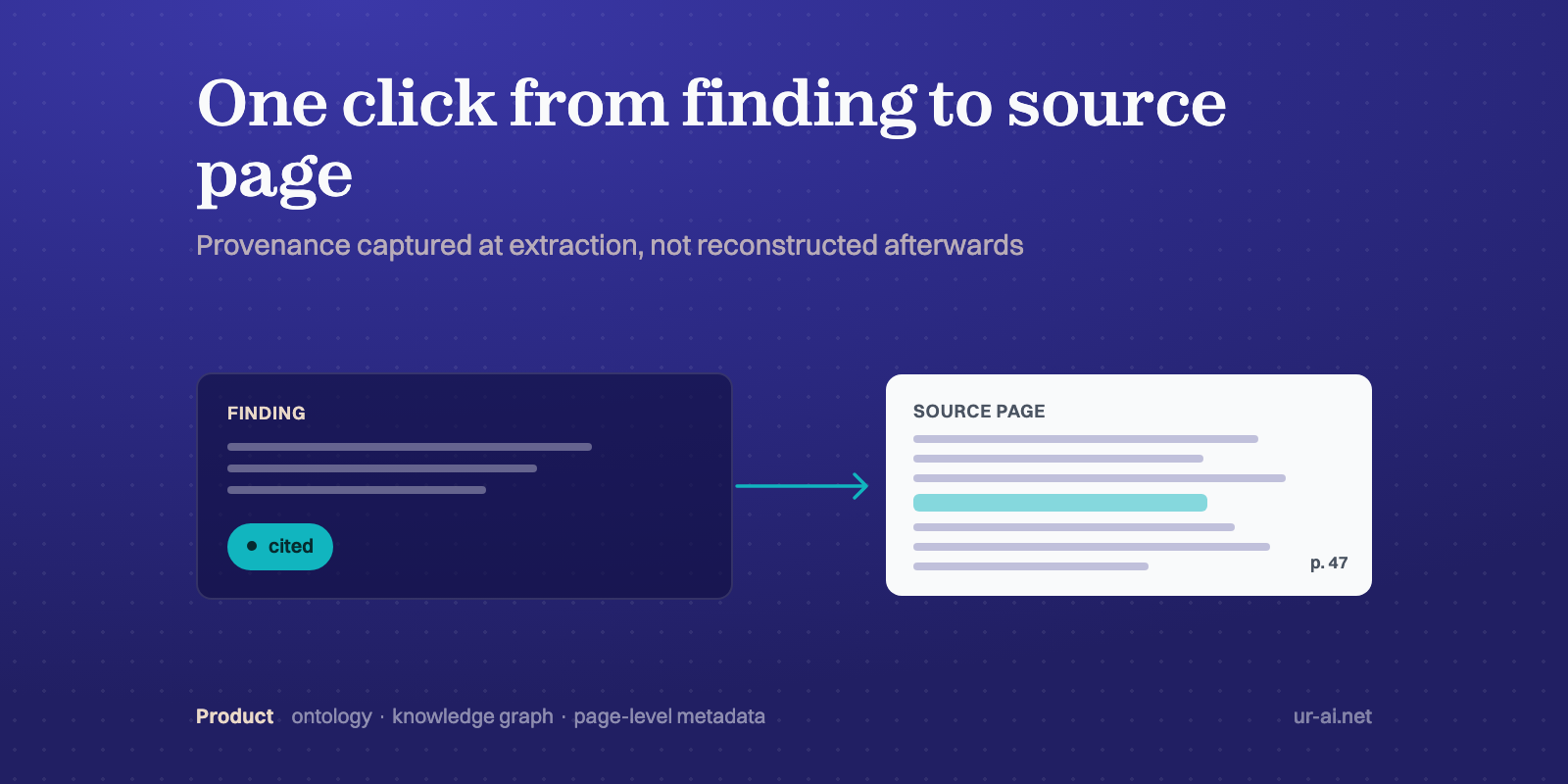
Most AI tools generate findings and then try to find sources for them afterward. Specter does the opposite: extraction is guided by a due diligence-specific ontology and knowledge graph from the start, so every finding is traceable to its source by design — not by best effort. The result is one-click, page-level citation verification that works for every finding, every time.
Why Other AI Tools Struggle With Verification
Generic AI tools treat citation as a retrieval problem: generate a finding, then search for supporting text. This approach is probabilistic. The AI may surface a passage that looks related, but it cannot guarantee that passage is the actual source — because the finding was not generated from that passage in the first place.
This is why 'AI-generated, human-verified' often means 'AI-generated, manually re-searched.' Verification that requires going back to the source documents is not verification — it is a second due diligence pass.
The Foundation: A DD-Specific Ontology
Specter's extraction is not freeform. It is guided by an ontology built specifically for due diligence — a structured encoding of what matters in deal analysis: corporate structures, financial statement relationships, contractual obligations, regulatory exposure, and risk categorizations specific to deal type and geography.
This is not a general-purpose knowledge base. It reflects the categories, hierarchies, and dependencies that a skilled DD analyst works with — legal, financial, tax, HR, technology — organized into a framework that Specter uses to structure every extraction from the moment a data room is loaded.
Deterministic Extraction via the Knowledge Graph
Built on top of the ontology is a knowledge graph that maps how entities and concepts relate across all documents in the data room. When Specter surfaces a finding — a change-of-control clause in a subsidiary lease, a financial covenant breach, a cross-border regulatory gap — it is traversing a structured graph of relationships derived from the documents, using the ontology to guide what to look for and where.
Extraction is therefore deterministic rather than probabilistic. Specter does not pattern-match across free text and guess at relevance. It knows why it found something, what structural relationship it represents in the deal context, and where in the document hierarchy the evidence sits.
We don't ask our users to trust the output. We give them the tools to verify it in seconds. That is the architectural commitment behind 100% auditability.
Minute-Level Metadata: Provenance at the Point of Extraction
Every piece of information Specter extracts is tagged with metadata at the moment of extraction: source document, page number, and positional context. This is not applied retroactively after the finding is generated — it is embedded in the extraction pipeline itself.
The consequence is precise: when Specter surfaces a red flag in your due diligence report, the citation is already attached. It was attached when the finding was created. Click the citation and you land on the exact page of the source document — not a document-level approximation, but the right page.
One Click to the Source Page
In practice, a senior reviewer can validate any finding in Specter's output without opening the data room separately, without running a search, and without re-reading surrounding context to reorient. The source is one click away. The page is the right page.
- Step 2 of Specter's workflow surfaces red flags for every risk item across legal, financial, tax, HR, and technology — each finding linked to the exact source page.
- Cross-file inconsistencies are flagged with citations to both conflicting documents, so reviewers can immediately assess the discrepancy.
- Jurisdiction-specific regulatory findings cite the relevant regulation from Specter's proprietary database covering 15+ countries alongside the data room document it applies to.
- Cross-language citations are supported — cite a Japanese-language source in an English report and navigate directly to the original page.
Auditability as Architecture, Not Feature
Specter's citation verification is a structural property of how the platform was built. The ontology defines the domain. The knowledge graph structures the extraction. The metadata pipeline ensures provenance is never lost. Together, they make 100% auditability an architectural guarantee — not a claim that depends on the AI performing well on a given document.
Every finding in Specter is traceable to the exact source page — by design, not by best effort. That is what 100% auditability means in practice.
Frequently Asked Questions
How does Specter's citation verification actually work?
Specter's citation verification works through three interconnected mechanisms. First, a due diligence-specific ontology defines the structured categories of information that matter in a deal — legal, financial, regulatory, contractual. Second, a knowledge graph maps entity relationships across all documents in the data room, enabling deterministic extraction rather than probabilistic guessing. Third, minute-level metadata is attached to every extracted piece of information at the point of extraction, recording its precise document and page location. The result: click any finding in Specter's output and navigate directly to the exact source page.
Can you trust AI-generated due diligence reports?
With Specter, yes — because trust is built into the architecture, not added afterward. Every finding is produced through deterministic extraction guided by a DD-specific ontology and knowledge graph. That means Specter knows why it surfaced a finding, which source passage supports it, and exactly which page in the document that passage lives on. Click the citation and you are on the right page in seconds.