Cross-Border M&A: How Multi-Language AI Analysis Changes the Game
Cross-border deals involving documents in multiple languages have always been among the most complex and expensive. AI is changing that equation fundamentally.

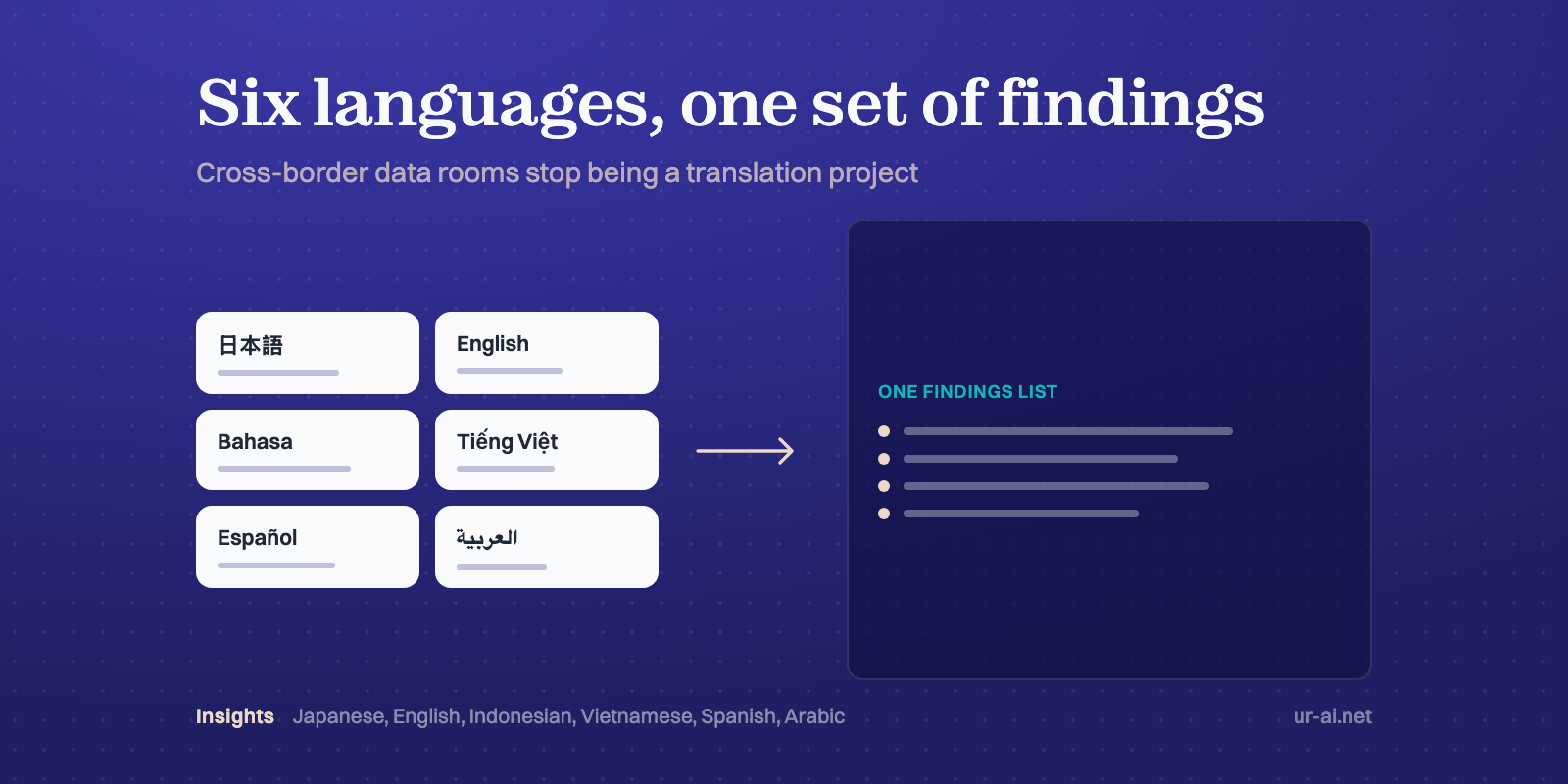
Specter's multi-language analysis is transforming cross-border due diligence by enabling deal teams to analyze documents in Japanese, English, Indonesian, Vietnamese, Spanish, Arabic, and other languages within a single workflow — without translation. According to Mergermarket, APAC M&A reached $884 billion in total deal value in 2024 — up 7% year-on-year and the strongest period for the region in two years — making multi-language capability a competitive necessity rather than a nice-to-have.
Japan is at the center of this activity. According to RECOF Data Corporation, Japan M&A reached a record 4,700 transactions in 2024 — up 17.1% and the highest annual count ever recorded. Outbound acquisitions totaled 665 deals worth $63.6 billion, up 16.9% in value, while inbound foreign investment surged to 333 deals with total value up 74.5% year-on-year. These are overwhelmingly multi-language transactions: Japanese acquirers reviewing English-language targets in the US and Europe, and foreign investors navigating Japanese-language data rooms. Every one of them faces the same bottleneck — documents in languages the deal team cannot efficiently read.
Sources
The Language Barrier in Due Diligence
Traditionally, cross-border due diligence requires either bilingual analysts (expensive and scarce) or translation services (slow and often imprecise for technical legal and financial language). A typical Japanese target might have contracts in Japanese, financial statements in both Japanese and English, regulatory filings in Japanese, and management presentations in English. Coordinating analysis across these language boundaries adds weeks to the timeline and significantly increases costs.
How AI Solves the Multi-Language Problem
Specter is natively multilingual. It doesn't translate documents — it understands them directly in their original language. This is a crucial distinction. Translation introduces errors and loses nuance; direct comprehension preserves the original meaning.
- Unified analysis — Documents in Japanese, English, Indonesian, Vietnamese, Spanish, Arabic, and other languages can be analyzed together in a single workflow. Specter identifies connections across languages that a bilingual team might miss.
- Cross-language citation — Findings can cite Japanese source documents while the report is written in English (or vice versa). Reviewers can see the original text alongside the analysis.
- Cultural and legal context — Specter is custom-trained on multi-language legal and financial corpora and understands jurisdiction-specific terminology and conventions.
- Consistent quality — Analysis quality doesn't degrade when switching between custom-trained languages, unlike human teams where expertise varies by language.
A Competitive Advantage for Asia-Focused Deals
For firms focused on the Japanese market — whether Japanese companies acquiring overseas targets or foreign investors entering Japan — Specter's multi-language analysis isn't a nice-to-have. It's a competitive necessity. With inbound M&A into Japan up 74.5% in value in 2024, foreign deal teams face Japanese-language data rooms at a scale and frequency that bilingual analyst capacity simply cannot keep pace with. The firms that can process a bilingual data room in days instead of weeks will win more mandates and close more deals.
Based in Tokyo, Ur AI built Specter with cross-border deals as a first-class use case. Japanese-English due diligence is not an afterthought — it's our core competency.
As cross-border deal volume continues to grow, the ability to seamlessly analyze documents across languages will separate the deal teams that can keep up from those that can't. The technology exists today — the only question is who adopts it first.
Frequently Asked Questions
How does Specter handle multi-language due diligence?
Specter is custom-trained for Japanese, English, Indonesian, Vietnamese, Spanish, and Arabic — delivering high-precision analysis in these languages. Specter also supports all other global languages with general multilingual capability, though performance may vary slightly for non-custom-trained languages. This enables unified analysis across languages, cross-language citations (citing Japanese sources in English reports), and consistent quality across your document set.
What are the challenges of cross-border M&A due diligence?
Cross-border due diligence faces language barriers (requiring expensive bilingual analysts or slow translation services), jurisdiction-specific legal terminology, cultural context differences, and coordination complexity across language boundaries. In Japan specifically, inbound M&A value surged 74.5% in 2024 (RECOF/JETRO), meaning more foreign teams than ever are navigating Japanese-language data rooms with limited in-house language capability.
Can Specter analyze Japanese documents for due diligence?
Yes. Specter can analyze Japanese documents natively alongside English, Indonesian, Vietnamese, Spanish, and Arabic documents. We have custom-trained Specter to accommodate these languages precisely. Specter can also analyze any other language but is not custom-trained for those, and performance may drop slightly.