From Data Room to IC Memo in Hours: A New Workflow for Deal Teams
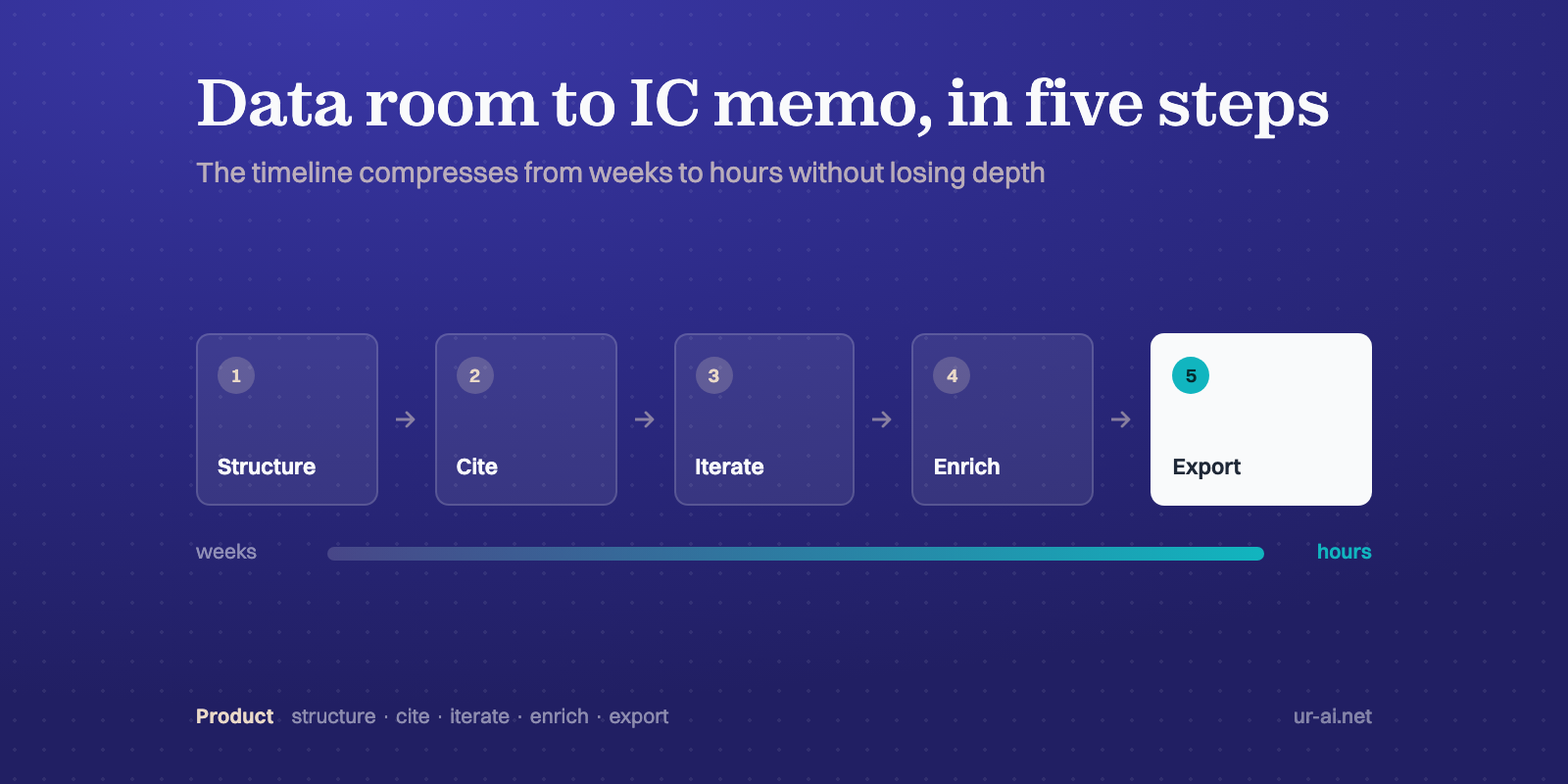
A step-by-step look at how Specter's AI-powered workflow compresses the due diligence timeline from weeks to hours without sacrificing depth or accuracy.

Between 70% and 90% of M&A deals fail to deliver expected value — a failure rate that has remained stubbornly persistent despite decades of methodological refinement, according to Harvard Business Review. With over $2 trillion USD in deal value at stake globally each year, the cost of getting due diligence wrong has never been higher.
The culprit is clear. Bain & Company research found that 60% of executives identify poor due diligence as the root cause of deal failure — not market conditions, not integration, not valuation. The foundation: the analysis done before the deal closes. And yet, 83% of PE practitioners admit that current due diligence methods are outdated, according to Mergermarket research and expert interviews.
Why the Current Process Fails
- Slow — Due diligence typically runs 3 to 12 months end-to-end, with data rooms demanding 190+ hours of analyst time per deal. Missed windows and delayed decisions are the norm.
- Expensive — A single deal costs $100K to $2M+ in professional fees, with analysts routinely running 100+ hour weeks during active diligence periods.
- Inaccurate — Over 40% of due diligence misses key risks. Manual document review is error-prone and inconsistent across teams and time zones.
- Shallow — Most workflows focus exclusively on finance and legal, leaving HR, technology, and operational risks under-examined or ignored entirely.
- Late — Critical risks frequently surface after the Letter of Intent, when deal momentum makes it harder to act on what you find.
Sources
Specter's AI-powered workflow was built to address exactly these failure modes — not by layering a generic AI assistant on top of a broken process, but by restructuring due diligence from the ground up. Five steps, full auditability, and human judgment at the center of every decision.
Step 1: Structure Your Due Diligence
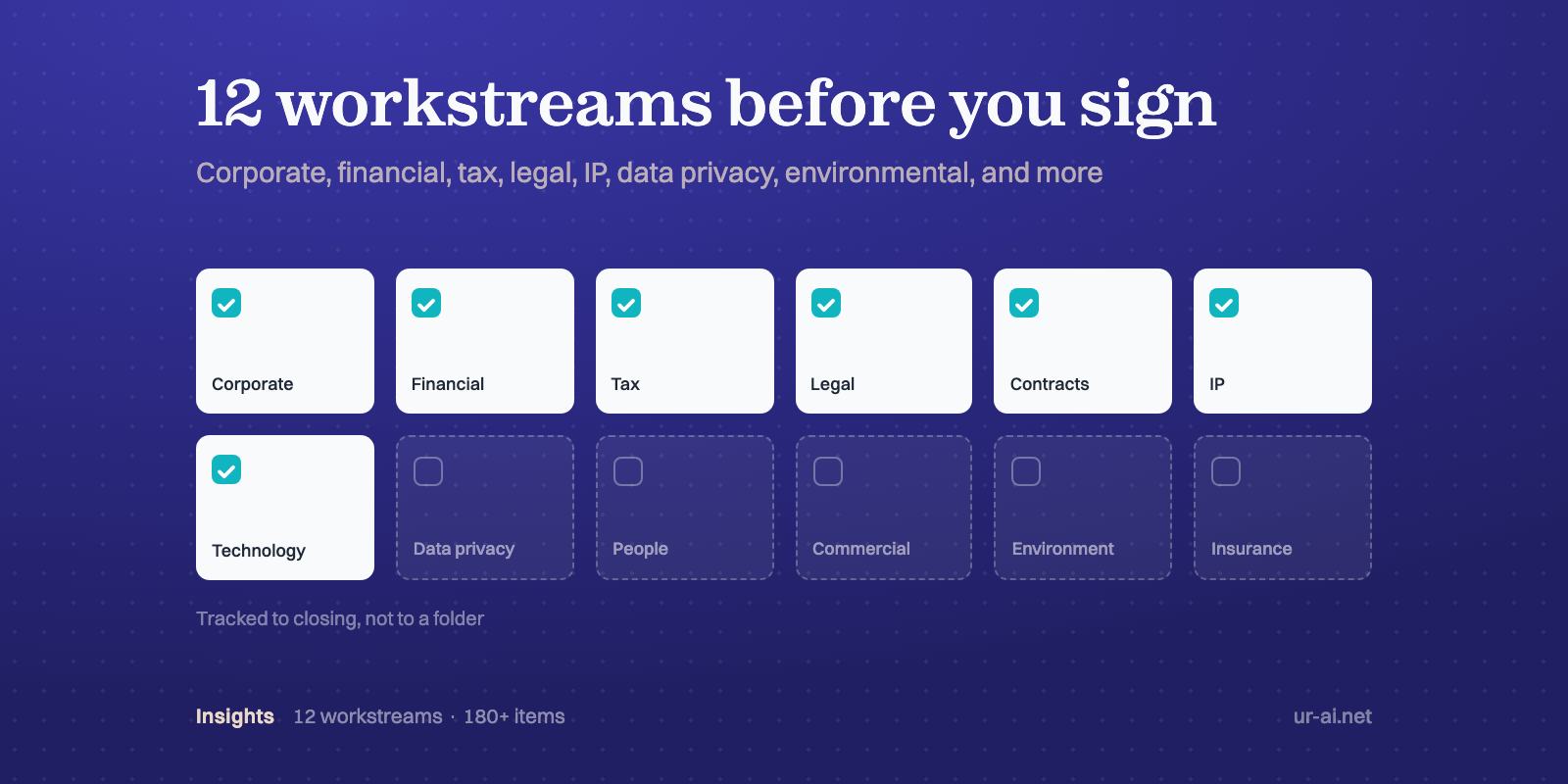
Connect your data room and define deal context — deal type (M&A, minority acquisition, VC, etc.), target sectors, and geographies. Specter generates a discipline-specific DD structure across legal, financial, tax, HR, tech, and more, calibrated to your inputs. Edit the structure freely — add or remove items — then Specter maps every data room file to the relevant risk items for your review and confirmation.
Step 2: Surface Red Flags, Every One Cited
With structure and file mapping confirmed, Specter surfaces red flags for every risk item from two sources: discrepancies across data room files, and legal, tax, and regulatory standards for your deal's jurisdictions. Every finding is fully verifiable — one click takes you to the exact page of the source document Specter referenced.
Step 3: Iterate with Full Version Control
Review findings and steer the analysis — direct Specter's focus, emphasize specific items, or flag areas that need deeper coverage. When new data room files arrive, Specter revises the relevant sections automatically. Versioning works at the section level: each risk item tracks its own revision history, so you can re-run only what you need and revert or compare changes item by item.
Step 4: Enrich with Live Web Intelligence
At any point, request Specter to pull live data from the web for a specific section or risk item. Review what Specter fetched before anything is added to your analysis. Approved outputs are stored as reports in a dedicated Web Fetches folder in your data room. Red flags for the relevant sections update accordingly, tracked as a new version.
Step 5: Export Deliverables, Your Way
Export a DDQ list to share with the target company, or a full DD report formatted for your Investment Committee — in Word or PowerPoint, built on your firm's own templates. Before generating, instruct Specter on pages per section, output language (English or Japanese), and any other section-level preferences.
The goal isn't to remove the human from the process. It's to remove the busywork from the human. Every hour saved on reading and formatting is an hour gained for critical thinking about the deal.
Frequently Asked Questions
What is an IC memo in M&A?
An IC (Investment Committee) memo is a comprehensive document that summarizes due diligence findings for decision-makers. It typically includes an executive summary, deal overview, key findings by category, risk assessment, and investment recommendations. Traditionally, IC memos take days or weeks to compile; with Specter, they can be generated in hours from your firm's own templates.
What are the steps in AI-powered due diligence with Specter?
Specter follows five steps: (1) Structure your due diligence — connect the data room, set deal context, and confirm a discipline-specific DD framework. (2) Surface red flags — Specter detects risks across data room files and jurisdiction-specific regulations, with every finding cited. (3) Iterate with full version control — give feedback per section, add new files, and re-run only what needs revision. (4) Enrich with live web intelligence — on-demand web fetches per section, reviewed and approved before entering the analysis. (5) Export deliverables — DDQ lists or IC reports in Word or PowerPoint, built on your firm's templates.
How does Specter structure due diligence for a deal?
Specter generates a discipline-specific DD structure based on your deal context — deal type (M&A, minority acquisition, VC, etc.), target sectors, and geographies. The structure covers legal, financial, tax, HR, tech, and more, and is fully editable before analysis begins. Specter then maps every data room file to the relevant risk items for your confirmation.